
 close
close


 LOGIN
LOGINYou are viewing
1 of your 3 free articles
Not too many cooks
Coaching Adviceby Sam Holmshaw
Former Ilkley Town manager Sam Holmshaw explains why he prefers working with a large backroom staff - and what they all bring to the party


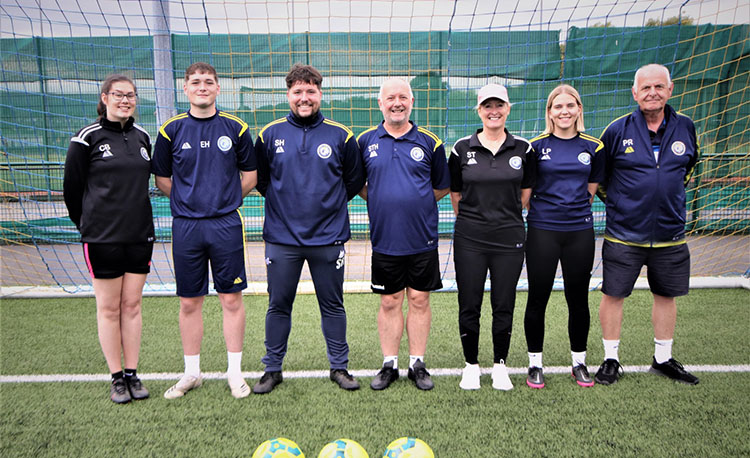
A question I was often asked during my spell as manager of Ilkley Town AFC Women, in tier eight of the English women’s pyramid, was: “Why do you have such a big coaching team at your level of the game?”.
Sam Holmshaw (third from left) with his backroom staff at Ilkley Town Women
It was an accurate observation. At one point we had nine coaches, which was then reduced to six for the current season. I admit it certainly is an unusual backroom set-up.
It has been partly influenced by my journey. I started coaching when I was 16 and, for the last eight years, I have been on the coaching ladder trying to develop and improve.
In 2016, I decided to study for an undergraduate degree in sports coaching at Leeds Beckett University and now find myself coming to the end of studying for a Masters degree in sports coaching.
What I learned at university informed my ‘unusual’ backroom set-up, as did the phrase ‘holistic development’.
Holistic covers the tactical, technical, psychological, physical and social sides of the game. As the head coach, I see it as my job to develop every one of my players in each of these areas, dependent on their age and stage of development.
Coaching is often dominated by the tactical and technical side, especially at the grassroots level of the game, usually due to time constraints. And that’s no different for me - every session we do is tactical.
Why? Because it is my job to win games for the club and, if you are a believer like me of the tactical periodisation school of thought (like Jose Mourinho), the game is tactical, and everything stems from the tactical aspect of the game.
“At one point we had nine coaches, which was then reduced to six for this season...”
It is my belief that a coach must work from a tactical standpoint, a model of how he or she wants the game to be played - usually conceived as the GAME model.
The GAME model is a visual representation of what a coach’s philosophy looks like in each moment of the game, and forms a guide to the decisions and actions we want our players to make in the game. It guides my practices, meaning they are dominated by the tactical element of the game.
However, as Portuguese academic Victor Frade suggests, every tactical decision and action requires a technical, physical, psychological and social element in order to allow the player to make said tactical decision and action
For example, If I want my player to score by making a late run into the 18-yard box and heading the ball towards goal (the tactical decision), my player needs to be able to head the ball (technical), sprint into the area and have the power to jump and head the ball (physical), shout for the ball using communication (social) and have the game awareness and confidence to act (psychological).
When my player performs that action of heading towards goal, they are performing all these elements simultaneously.
So, as the coach, I need to know the tactical decisions and actions I am asking my players to perform - and what skills or competencies are required from each holistic element to allow her to make this decision.
Related Files
WSC-011-not-too-many-cooks.pdfPDF, 887 KB
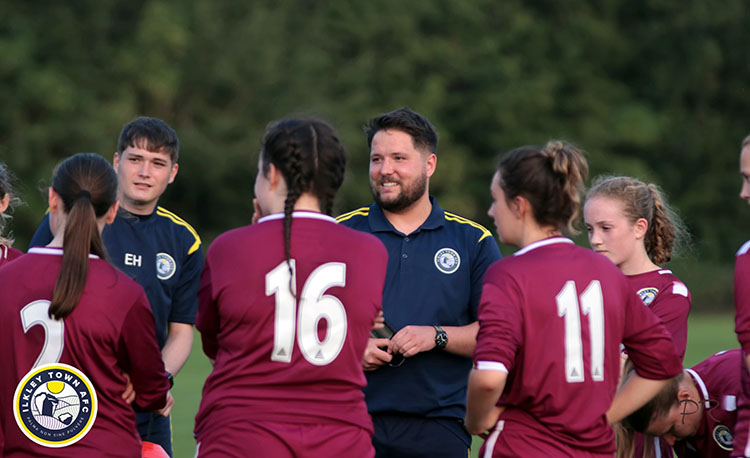
Sam Holmshaw pictured during his time in charge at Ilkley Town AFC women
This is where my coaching team comes in. Like I said before, my sessions are dominated by the tactical side of the game.
We have one session a week, so I need to optimise that time working on attacking and defensive principles to help my team win the game on a Sunday. At our level, I don’t have the time to work on each holistic area myself - instead, I bring my coaching team in to do that for me.
My assistant manager Ethan and assistant coach Simon specialise in the technical element. While I am leading the session, they may add in rules or constraints to work on certain technical aspects - it may be a rule for a specific player to only play one-touch passing and receiving in a small-sided game.
My mental skills coaches, Liv and Carla, may ask that only one player on the team can communicate, to help improve her communication skills needed for Sunday - it also reminds the other players of how important communication is.
My strength and conditioning coach Jess might add a further rule where one team has to run to the goal and back upon possession loss, to work on their sprinting. Can you see where I am going with this?
So within a training session, while I lead on the tactical element, the players will simultaneously be working on other areas through constraints put in place by the other coaches.
What is more, the mental skills coaches do a lot of off-field work with the players, developing confidence and helping the younger players feel comfortable playing in the first team.
I don’t have the time to look at every holistic area for every player - my role is to coach the team tactically, through the use of formations, shapes, principles of play and so on.
Instead, I assign a holistic area to one of my coaches, satisfying the needs I can’t fulfil.
“I assign a holistic area to one of my coaches, satisfying needs I can’t fulfil...”We believe that each of these areas is of vital importance to allow our players to perform at an optimum level, so we should treat each area seriously.
All of this allows my players to, firstly, be better at performing tactical decisions and actions in the game, but also improve a lot of areas which may help them outside of football.
My team and I place a huge focus on life skills, such as developing players’ ability and confidence to be able to talk in front of a crowd, so they can then do it at university presentations, or work conferences.
In fact, maybe the best element of my coaching team is the support network we provide for the players. After all, when a player needs help in any area of their lives, it is not just me - there are six of us to help them through it.
It is something that is mirrored more and more these days at professional clubs, with psychologists and strength and conditioning specialists being added to the coaching mix.
Ultimately, as coaches, it is our job to look after our players and oversee their individual holistic development. But this is too much for one person alone.
To do it properly, you need a few individuals to help out - and this underlines the importance of volunteers within amateur and semi-professional sport.
Don’t get me wrong, we are no experts at Ilkley Town - most of us are young students learning our trade.
But through this coaching set up, I think we can offer our players more support in their ongoing development as both players and people - and, after all, isn’t that the job?

Latest Content
Subscribe Today

Newsletter Sign Up
Subscribe Today
Newsletter Sign Up
Subscribe Today
Latest Issue

Discover the simple way to become a more effective, more successful soccer coach
In a recent survey 89% of subscribers said Women's Soccer Coaching makes them more confident, 91% said Women's Soccer Coaching makes them a more effective coach and 93% said Women's Soccer Coaching makes them more inspired.
*includes 3 coaching manuals
Get Inspired
All the latest techniques and approaches


Women's Soccer Coaching offers proven and easy to use soccer drills, coaching sessions, practice plans, small-sided games, warm-ups, training tips and advice.
We've been at the cutting edge of soccer coaching since we launched Soccer Coach Weekly in 2007, creating resources for the grassroots youth coach, following best practice from around the world and insights from the professional game.
