
 close
close


 LOGIN
LOGINYou are viewing
1 of your 3 free articles
Gemma Grainger: ‘There are no easy games’
Norway manager Gemma Grainger is leading the two-time European champions at Euro 2025. She tells Carrie Dunn about her approach and her journey to the top
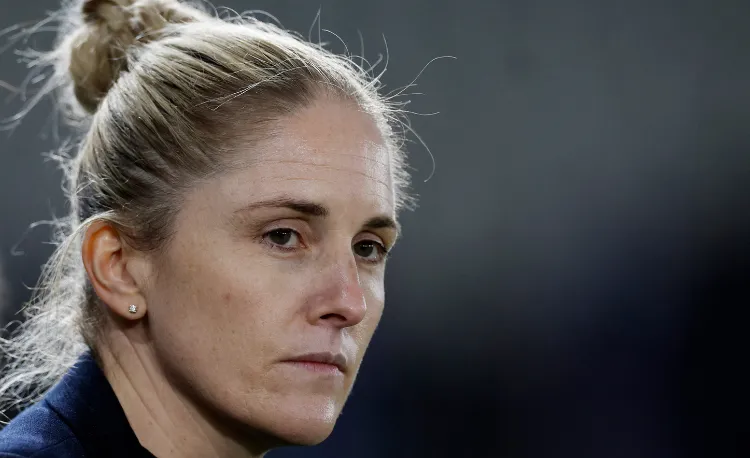
Norway are a team with a storied history in women’s football. They won the Women’s World Cup in 1995, are two-time European champions, and were Olympic gold medallists in Australia in 2000.
Gemma Grainger is the woman tasked with bringing the glory years back to Norway, beginning with the Women’s Euros this summer.
“I’m very aware of the history,” says Gemma. “I’m very aware I currently wear a national team badge that has a star above it. There are not too many of those badges, so there’s a big awareness for myself.
“Norway are very proactive, very forward thinking; the country is as a whole, so when it comes to equality here, women in society but also women in sports, it’s so much more progressive than many countries. The team really was ahead of their time.
“One of the challenges we face now is that [in] the women’s game, everyone is investing at such a high level, so we have to keep investing. But also, we know the strengths that we have: making sure that the culture here is super special in terms of that quality and that forward thinking.
“Women’s football, in my opinion, at international level, has never been more competitive. So there are no easy games.
“I truly believe that, and it’s great for the game. We have new teams qualifying for tournaments. For us personally, we’ve got to keep pushing and taking steps forward because then we give ourselves the best chance of being successful.”
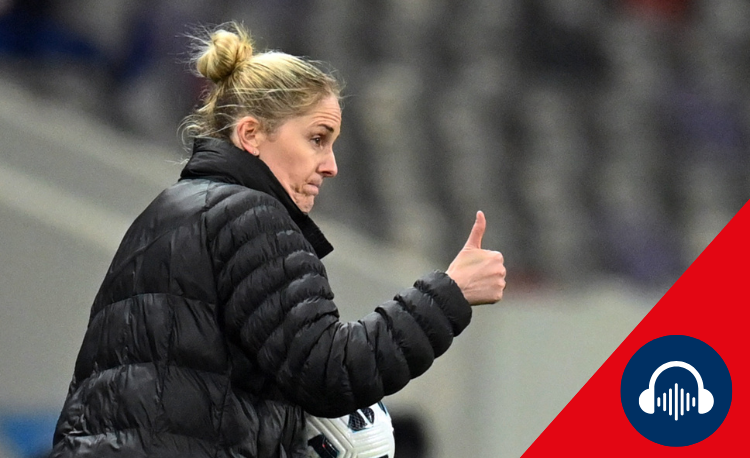
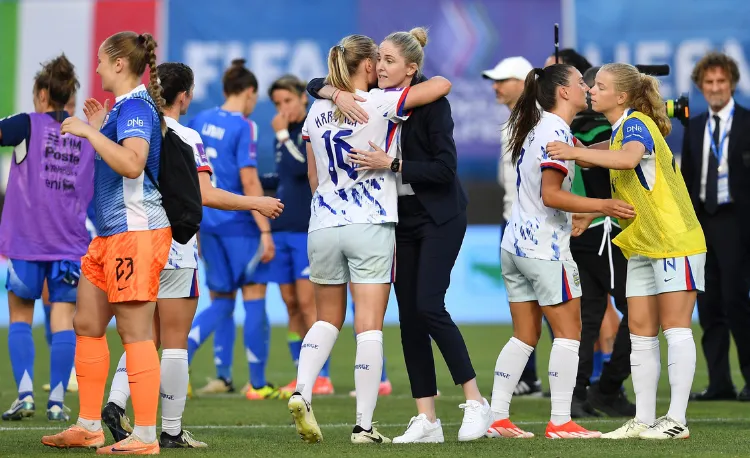
The run up to Euro 2025
Preparing for the Women’s Euros has been a challenge in itself. Gemma has players in eight different leagues across Europe, so coordinating training schedules has been tricky, requiring plenty of liaison between clubs and the national team’s staff.
“When the players come in, we often face different challenges to club managers. So right now, the players who aren’t in club, they’ve had a holiday, so from a mindset perspective, we’re trying to help them come back into it slowly, and technically as well, and it’s building that up.”
The weeks immediately prior to the tournament have given Gemma both the best moments and the worst of her career – making the calls to tell players whether they are in or out of the squad for the summer.
“It takes a lot of time to prepare, and once we’ve made decisions, that’s the job that I have. It’s my job to make the call. The technical team will, of course, support me in that process for selection, but the call comes down to me.
“I make sure it’s a call face to face. Obviously, players are around Europe, so it’s not always possible to sit with them, but it’s a call, and it’s a well prepared, honest call.
“When you deliver news that’s not so good, it’s normally a short call with an opportunity to follow up, and the opposite calls are some of the best calls that I make.”
Co-coaching in the Norway set-up
With limited time during each international window, Gemma works closely with her staff so that she is able to observe players in action, operating with five coaches pitchside, including two assistants, a goalkeeping coach, a set-piece coach, and herself.
“We do a lot of co-coaching where when we have one session on, we’ll have one coach that leads the session. Then we’ll have two or three coaches who have specific roles, whether it’s to focus on the principles or to focus on the outcomes of the session or the behaviours that we want to see in the session.
“Then I often can take an overview of that, so I can step in and lead at any point, but also I can step back.
“We really plan well who is looking at what, and then we’ll review after the session, because international coaching, you have the time on the pitch and you want to impact the players, but we obviously have a lot of time off the pitch as well, so we get to sit down, have those individual meetings, which are very nice to do.”
Environment and style of play
As a technical observer at both the 2022 Women’s Euros and the 2023 Women’s World Cup, Gemma was already very familiar with the players she would be working with when she took on the Norway job.
“Before I came into the group, I’d watched the last two tournaments and the team had openly said they didn’t meet the expectations that they wanted to. For me, it was about asking some good questions about, ‘Okay, why was that? What do you think we need to do?’
“Ultimately, when you work with an international group, it’s about creating an environment where the players want to be here. It wasn’t that they didn’t want to be there before, but for me, it was more about making sure the environment was an environment that allowed them to lead, an environment that allowed them to be themselves, and maximise their strengths.
“We have a real mix of players, of individuals, and we have to get the best out of everybody, so we put a big focus on that. Since I’ve been here, I’ve had 18 competitive games. Now that’s crazy because I haven’t had a friendly game yet! It’s been great to have so many competitive games, but we’ve had to implement the style of play and what we want to do in competitive fixtures.”
That style of play has quickly been tailored to the group’s strengths.
“We thought, ‘Okay, how can we be most effective without the ball? How do you think we can be most effective with the ball?’ That’s what we looked at, and so we’re constantly focusing on us. The challenge is that we’re always trying to be better at what we do, and that’s how you find the balance, because, ultimately, if you keep getting better, then the results will - or should - correlate with that.
“If we focus on getting better in in everything that we do, then we’ll obviously, win more games than we lose.”
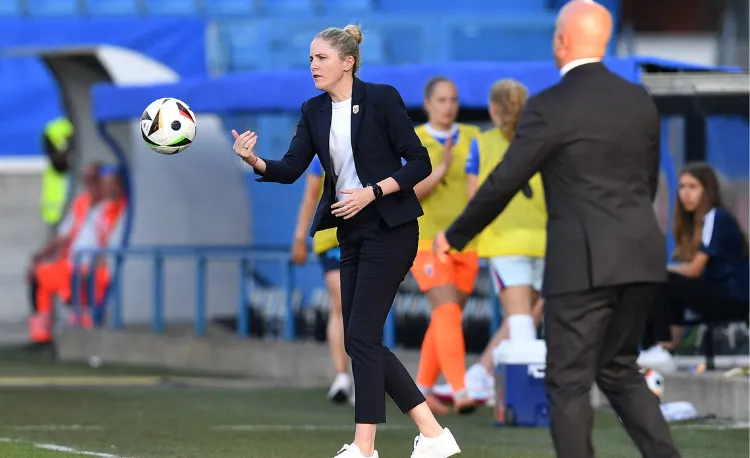
Gemma’s journey to the top
As far back as she can remember, Gemma watched football, first cheering on her dad in his matches, and then going to watch Middlesbrough. She was a player herself, reaching the regional academy for the north-east in Durham, where she was coached by Ted Copeland, formerly the England Women manager, who invited her to join him in coaching an after-school session.
“I fell in love with it from that moment, because I love football, and then I loved teaching people or helping people to realise what they’re good at, how I can help them, and I really do enjoy spending time with people.
“Communication, building relationships, I think they’re the core skills of any good coach or good leader, and you start with that as well as obviously the technical and tactical understanding.”
When Gemma was 18, she began coaching on Middlesbrough’s Football in the Community programme, picking up sessions throughout the week, and ensuring she had a bag of footballs, a stack of cones and discs and a set of bibs in her car at all times. It was a formative experience, and she decided she wanted to make it her career, even though it seemed almost impossible without a professional women’s league in the UK.
“I said to my mum, ‘Mum, I’m going to be a football coach,’ and she said to me, ‘Gemma, I think you should be a PE teacher.’ My mum was obviously trying to protect me, she didn’t see the route, and I didn’t see it either, but it wasn’t about the route. I knew that there were international teams, I’d worked at Leeds United Ladies, who were an amateur club but I was working with the best players in the country at that time.
“I look back to my time at Middlesbrough Football in the community: I remember Beth Mead coming into a sports hall where it was a pound a session on a Friday night, with her dad Richard. Jordan Nobbs was in the team that I was taking on a weekly basis. I was working with Rachel Daly at Leeds.
“I got into the regional FA in 2005 and just never really looked back from there.”
Gemma was working at North Riding FA as a women and girls’ development officer and still coaching on the side, which put her in a great position when the FA Tesco Skills Programme launched in 2007 and needed 100 full-time staff working with children aged from five to 11. She spent five years “coaching flat-out” as she put it, and getting the opportunity to work with England Women’s Under-19s courtesy of head coach Hope Powell.
“Honestly, it just snowballed. When I look at how that happened, I’d never seen myself in this position. If you’d said to me back then, ‘Gemma, you’ll manage a team, the stadium will be sold out, there’ll be 35,000 people in it,’ I’d have been like, ‘No.’ I could never have seen the women’s game do what it’s done, so I guess you could say there’s a little bit of luck there, but I also think the luck was alongside just the pure passion.”
Essentially, Gemma simply loves coaching. If the 18-year-old taking her first tentative steps into the profession would take advice from her, she would remind her to enjoy the journey.
“The last thing I say to every player before they leave the changing room when I high-five them on the way out: ‘Make sure you enjoy yourself,’ and that’s true. Whether you’re a senior international, whether you’re a five-year-old playing for the first time, my job is to make sure that I’m the coach that makes sure that you enjoy yourself.
“People laugh when I say this: I haven’t really worked a day in my life, but then I’m incredibly hardworking. People are like, ‘You’re obsessed with football, why are you watching it, why are you watching this?’ So I am working hard, but it’s something that I just truly love, so it’s hard to say that it’s a job.”
The coaches that inspired Gemma
Gemma has been inspired by plenty of big-name coaches across the game. She picks out the former Germany head coach Silvia Neid and assistant Ulrike Ballweg, who invited her to spend some time with them when she was embarking on her UEFA Pro Licence.
“To say they had an influence on who I am and what I do would be really accurate,” she reflects.
She also values her relationship with Emma Hayes, with whom she completed her Pro Licence, as well as the coaches with whom she worked in the England set-up, including former men’s manager Sir Gareth Southgate.
“I had the privilege of working alongside people like Gareth, Steve Cooper, Neil Dewsnip, and these are coaches whose numbers are in my phone and I can make that call for advice,” she says, “so I feel very grateful to have that opportunity.”
“To play a small part was an absolute privilege for me” – Gemma on her former team, Wales, qualifying for the Euros
Gemma’s former team Wales will also be in the summer’s Women’s Euros, and she is delighted to see them on the big stage for their debut at a major international tournament.
“My job was very clear when I went to Wales,” she says. “The FAW invested with the goal to qualify for the European championships in 2025. We got very close to qualifying for the World Cup in the 2023 play-off. We did so well then. We were a little bit ahead of where we maybe should have been.
“For me, it’s great to see Wales qualify because that was a part of my journey, and my aim is always to leave the team in a better place both on the pitch and off the pitch, and to play a small part in that was an absolute privilege for me.”

Carrie Dunn
Latest Content
Subscribe Today
Newsletter Sign Up
Subscribe Today
Newsletter Sign Up
Subscribe Today
Latest Issue
Discover the simple way to become a more effective, more successful soccer coach
In a recent survey 89% of subscribers said Women's Soccer Coaching makes them more confident, 91% said Women's Soccer Coaching makes them a more effective coach and 93% said Women's Soccer Coaching makes them more inspired.
*includes 3 coaching manuals
Get Inspired
All the latest techniques and approaches


Women's Soccer Coaching offers proven and easy to use soccer drills, coaching sessions, practice plans, small-sided games, warm-ups, training tips and advice.
We've been at the cutting edge of soccer coaching since we launched Soccer Coach Weekly in 2007, creating resources for the grassroots youth coach, following best practice from around the world and insights from the professional game.
