
 close
close


 LOGIN
LOGINYou are viewing
1 of your 3 free articles
Amy Merricks: Ambitions aligned
Amy Merricks is currently leading Birmingham City’s campaign for promotion to the WSL. She tells Carrie Dunn how they’re going about it, and how her coaching journey led her to a club where the ambitions match her own


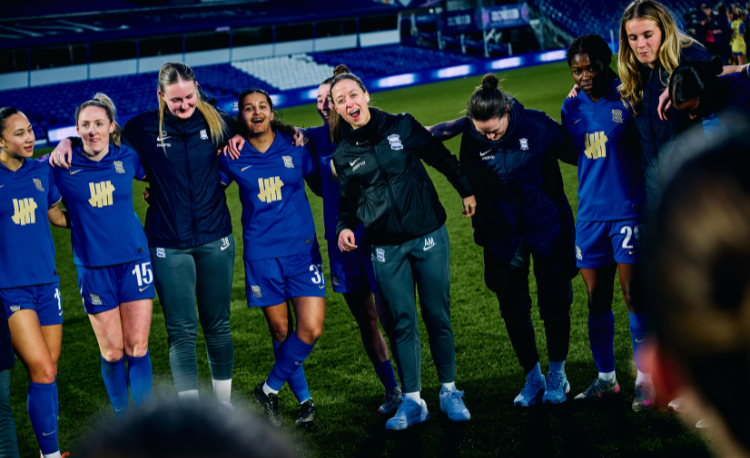
“You are leading a ship, and your job is to make sure you inspire, you motivate, and you develop people every day.”
Amy Merricks is one of the brightest coaching prospects in women’s football. The Women’s Super League’s youngest-ever head coach during her interim spells in charge at Brighton and Hove Albion, and previously head coach of England under-19s, she is now fully focused on the target of leading Birmingham City back to the top tier.
February’s international break gave her the chance to reset and refresh ahead of an intense run-in to the end of the season – a stretch of matches that includes a Women’s FA Cup quarter-final against WSL giants Manchester City.
“When you’re going game after game, it’s nice to just pause, breathe, see your family, see your friends that you maybe tend not to see as much,” she says.
Amy describes herself as a perfectionist – and admits that it’s “an ongoing juggle” to carve out time to take care of herself during a hectic season, so these periods to ‘breathe’ are important.
“I recognise if you don’t balance it, then you become more subjective in your decisions and emotionally driven when actually you need to be really objective, you need to be calm and composed,” she says.
“That’s why we’re in the roles, because we strive for excellence all the time. And I think it’s something that we need to keep discussing.
“We talk a lot about well-being for players, but maybe we don’t so much for coaches, and I think it’s a really important space to delve into more and make sure people have the balance, the care, the time that they need to take so that they can be high performing all the time.”
And once she’s taken a breath, it’s time for review.
“The next stage for me is to reflect. So we tend to look at block reviews, where we look at the most recent run of games, and we do a comparison in terms of our game model and our KPIs and where are we?
“Where are we maybe falling short? Where are we really striving? What can we build on and what might we need for the next run? So then we’re looking at planning. You’re planning for what’s coming next, which is a really busy and important period for us.”
Birmingham City: the push for promotion
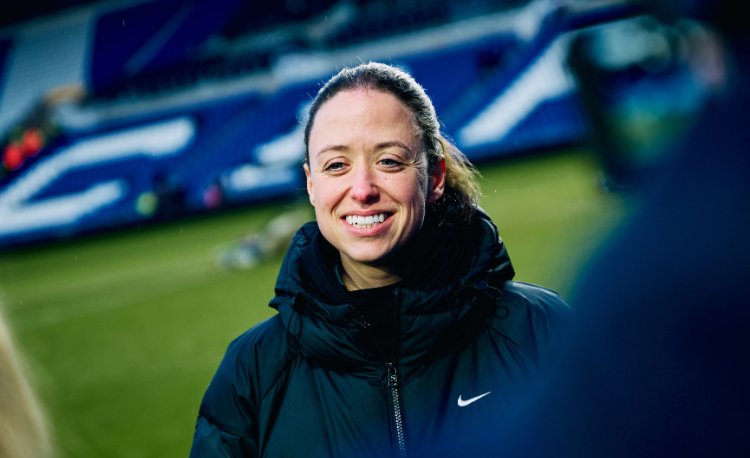
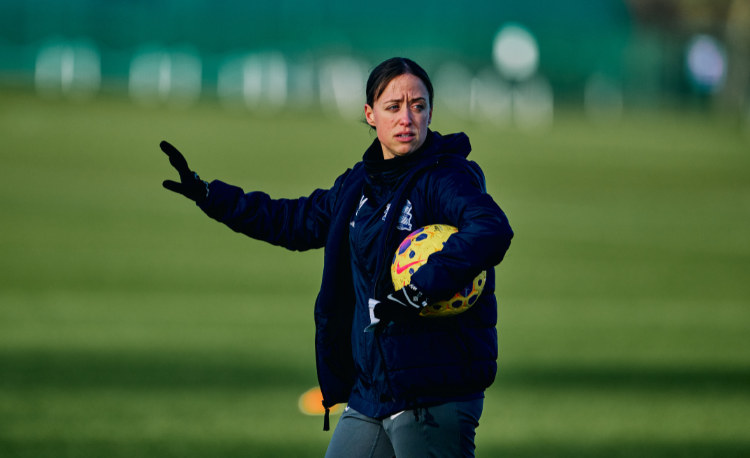
Birmingham City have been challenging for promotion since the start of the season, and with the top flight expanding, it’s crucial for the Blues to maintain the pressure on the league leaders.
“I love the league. I think it’s extremely competitive and that’s what you want. We’re in a really good spot. We’ve done some great work so far and we have everything to play for.
“When I look at the season as a whole so far, I think we can be really proud of the work that we’ve done and the position that we’re in, and we’re just eager now to earn the right in the business end of the season - we still have everything to play for, which is fantastic.”
It’s also an exciting time for the women’s team off the pitch, with new investment coming in, headed up by club legend Karen Carney as well as another icon of women’s sport, tennis superstar Kim Clijsters.
“It doesn’t affect the day-to-day, but what’s really nice is we have a real clear sense of direction aligned to the ambition that we have as a club. We’ve been put on par with the men’s team, which is, I think, a really nice statement.
“The club have been really keen to make sure we have female leaders at the forefront of the women’s side of the club…someone like Karen Carney, who means a lot to us as a team and as a club and embodies everything about the Blues, it feels very much connected to what we’re trying to achieve on the grass.
“It will give us a really nice touchpoint around elite and high performance women’s sports as we push into those realms of the game, because that’s what we’re pushing for: WSL, Champions League.”
Why being an assistant coach is ‘the best’
In her younger years, Amy considered becoming a PE teacher – but after seeing the admin her history teacher mother had to do, she changed her mind. Still, she loved playing football, and describes herself as a “very efficient” player.
“I would say my biggest strength was being able to read the game. I spent the majority of the game when I was playing communicating and reading the game and always thinking ahead to the next steps.
“I always remember my grandad said to me, ‘You might not be able to cover the ground as quickly, but you can read the game well.’
“I had this tactical side I was always very curious about.”
She took up coaching while she was still playing, inspired by noticing her own development under a particularly enthusiastic coach at Crystal Palace, and loved it immediately.
After spells at Gillingham, Chelsea, Millwall Lionesses and the Kent FA, she went on to coach through the age groups at Brighton, starting with the under-13s. She served as assistant manager there for seven years, supporting George Parris, Hope Powell, Jens Scheuer and Melissa Phillips – and filled in as interim head coach after the departures of Powell and Scheuer.
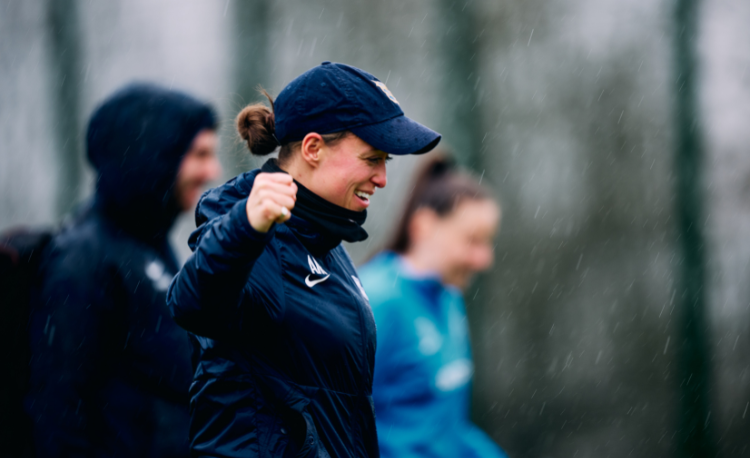
“An assistant coach role is the best role in the world of football, in my opinion. You get to deal with the players, you get to coach, you get to deal with the football 24-7. The only downfall is you don’t get to make the decisions. You probably get to a point at some point in your coaching career, like I did, and you’re itching to be the one that makes the decisions and see if your philosophy and your style stands up and will be successful.
“I was very fortunate because five years of my time as an assistant coach with Brighton was under Hope Powell, who took me from being really just an assistant to actually being ready to lead the programme, and there were days when she would step away and I was able to step into those shoes, so I had a really nice transition.
“[As an assistant] you get a chance to really focus on the rapport more with solely the players and influence their performances and the team’s performances that way, whereas as a head coach, the reality is you have to lead and you have to coach, but you also have to manage. You have to manage the playing team, you have to manage the staff team.
“I think the reason why I’ve been able to maybe transition to being a head coach probably a little bit more seamlessly than maybe others - because it is tough - is because I was allowed to lead in my assistant role.
“I had projects that I was leading on and that’s certainly how I try to work here with the assistants, because they have skill sets that I don’t, and I need to make sure they are empowered and have the opportunity to lead their areas and their projects whenever possible, because I really believe in getting the best out of the people that are in your team.”
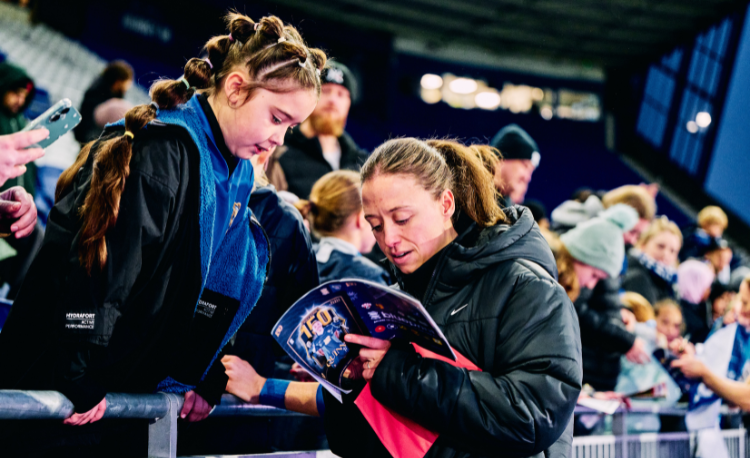
Learning from other industries
During her professional development, Amy has sought out ideas from other industries, explaining: “Regardless of the badges you have, you can learn something from absolutely anyone, any sport, any business.”
She met with the Royal Tank Regiment as part of her UEFA Pro Licence study, and used it as an example of the importance of clear communication.
“If you’re working a tank, you’re at war and it’s life or death. We’re not life or death. But there were some real nuggets that you can take from being in the game and how you support and encourage your teammates in critical times of battle.”
She also delved into the world of West End theatre and explored the world of the understudy, who steps in if one of the lead performers is indisposed. She then took those ideas and applied them to the substitute in football.
“How do we make sure they feel valued? How do we make sure they are ready to perform and fulfil their role? I think there is crossovers in our world and I think there’s a real danger that we get stuck in our world when actually we need to break out.”
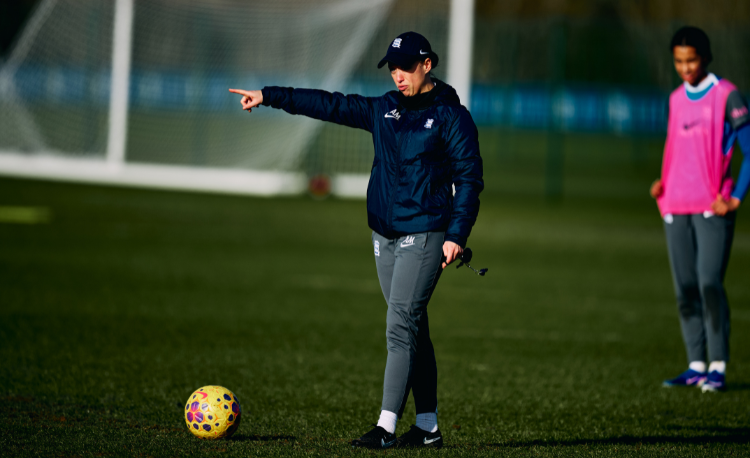
Being on the grass every day
Amy was appointed as head coach to the England under-19s in April 2023, a role in which she stayed for a year. She says that working in the England talent pathway taught her a lot, particularly when it comes to development off the pitch, and clarity of communication in a limited amount of time.
“Trying to get those players aligned and on one page in a short space of time is very challenging, and I loved it. I absolutely loved it, particularly the camps. The challenge for me was that the camps were the only grass time you really get, and that was a massive adjustment for me going from working in the domestic game for eight years non-stop to then just maybe periods of 10 days, as and when. That was tough for me - hence why I’ve come back into the domestic game now.”
In fact, she always intended to return to the domestic game at some point. Her opportunity came in the summer of 2024, when she was appointed as head coach at Birmingham City – a club with huge ambitions that align with her own.
“Taking the England role was timely for me. [I spent] eight years at Brighton [as assistant and interim head coach] and it was really nice for me to see things from a different angle. It was also my first official head coach role, if you like, and to be able to do that on national stage is a real privilege. I really relished it and so grateful for [then-women’s technical director] Kay Cossington and [then-technical lead and head of women’s development teams] Shelley Kerr for believing in me.
“But then likewise, the Birmingham job coming up was equally really timely for me. I was itching to get back on the grass day-to-day.
“And I think for where I am right now,” she concludes, “my career working with staff and players every day is only hopefully going to develop me even further as a coach and as a manager.”

Carrie Dunn
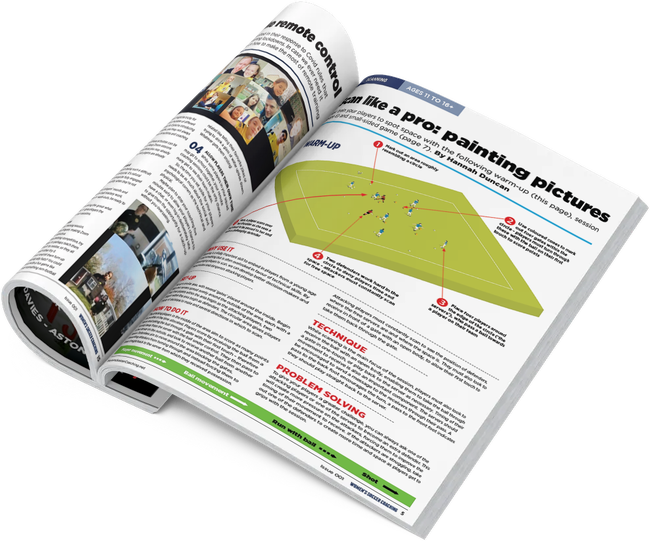
Latest Content
Subscribe Today
Newsletter Sign Up
Subscribe Today


Newsletter Sign Up
Subscribe Today
Latest Issue
Discover the simple way to become a more effective, more successful soccer coach
In a recent survey 89% of subscribers said Women's Soccer Coaching makes them more confident, 91% said Women's Soccer Coaching makes them a more effective coach and 93% said Women's Soccer Coaching makes them more inspired.
*includes 3 coaching manuals
Get Inspired
All the latest techniques and approaches


Women's Soccer Coaching offers proven and easy to use soccer drills, coaching sessions, practice plans, small-sided games, warm-ups, training tips and advice.
We've been at the cutting edge of soccer coaching since we launched Soccer Coach Weekly in 2007, creating resources for the grassroots youth coach, following best practice from around the world and insights from the professional game.
