
 close


 LOGIN
You are viewing
3 of your 3 free articles
Del Morgan: Building the goalkeeper pathway
Goalkeeper development and pathway lead at Liverpool, a club she used to play for, Del Morgan tells Carrie Dunn about her ultimate job: producing a goalkeeper to play in the Reds first team


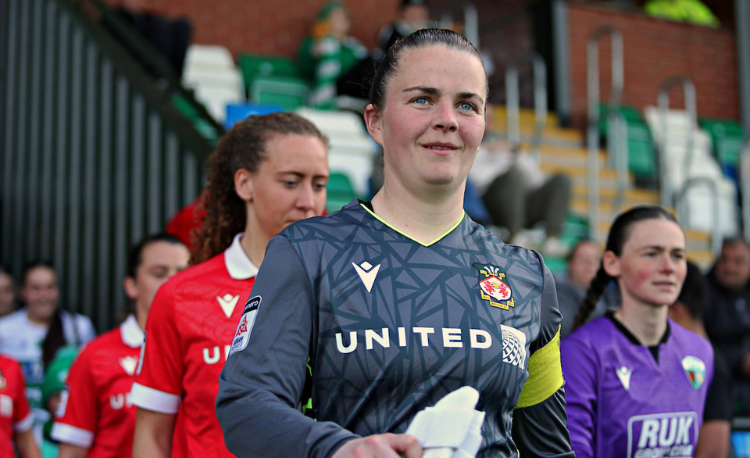
Delyth ‘Del’ Morgan is the first woman in Wales to hold both the UEFA A and UEFA Goalkeeping A Licences.
With spells at Wrexham, Everton and Liverpool on her playing CV, the goalkeeper has spent over a decade developing her coaching while also continuing her career on the pitch. Now fully focused on coaching, earlier in 2026 she was awarded her outfield A Licence, marking not only a national achievement but a personal milestone.
“It’s been a real journey, to be fair,” she says. “Because I am very goalkeeper-orientated, the outfield badges were a bit of a challenge. So I took a break and then after a couple of years, I’m someone who always wants something to work towards, because if I’ve got no challenge and I’m just sitting still, I don’t feel like I’m doing myself justice professionally, I don’t feel like I’m going to do the players I work with justice.
“So I just applied for the outfield [licence] and I’m glad I did it, but I don’t want to do it again, let’s put it that way. It was a really tough year. I found it hard, but in a great way. It really put me out of my comfort zone. It’s helped me see the game in a different way rather than just through a goalkeeper’s eyes. I found as well as the year went on, I was looking at the game from an outfield point of view. I was able to adapt it and help support the goalkeepers in a different way and help them understand the game more.”
‘We have to be ruthless’
She works as goalkeeper development and pathway lead at Liverpool Women, focusing on bridging the gap between the first team and the juniors, making sure that goalkeepers are coming through all the age groups, with the ultimate aim of producing one to play in the first team.
With so few professional spots available for goalkeepers, it means that Morgan has to make some difficult decisions when it comes to the young players she works with.
“Goalkeepers don’t tend to hit their prime until they’re 26 plus. We’ve got to make a decision when they’re 18 years old, if we’re going to give them another year on their scholarship, on their contract at the club, because we have to be ruthless.
“It’s my job as well just to look at each individual coming through. I might have a talented goalkeeper in the [under-]21s now, but there’s someone below [that age group] that’s coming [up].
“I won’t be able to produce a [potential first-team] keeper every year, so I’ve got to probably every few years think about who’s the one that we want to push through. So it’s hard decisions and you’ve got to be so ruthless. Probably my least favourite part of the job is when you have to let the players go.”
Morgan combines her experience and insight as a coach with the data offered by testing to help her make those choices.
“I’m a goalkeeper coach who likes to form close bonds with the goalkeepers as well. Just for me, that’s just the way that works. I feel like if I know them as people as well as the player, I know how best to get things from them. When they’re going through tough moments, so they’re low on confidence on the pitch, how do I get them going again? How do they take feedback? Do they want me to be firm and direct and straight to the point? Do they want me to put their arm around them? Everyone’s so different.
“The nature of being a goalkeeper coach, you do get to have those relationships with the goalkeepers because we’re just working as a small group in a way that the outfield coaches can’t have with their team, and that’s one of the reasons why I love being a keeper coach.
“My job is to try and produce a keeper for the first team, but if that doesn’t happen, then my next job is developing them for the game…When they leave Liverpool, they’re going to play to their highest ability and they’re going to have a good career and they’re going to enjoy their career, wherever that may be.”
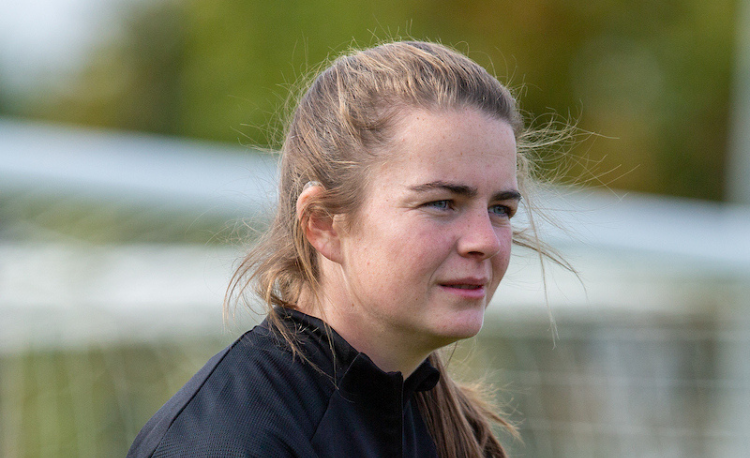
‘Goalkeeper coaches are part of the session’
Morgan had a successful trial at Liverpool as a youngster, and that was when she first had top-tier specialist coaching. That was from Jen Hurst, now Canada Women’s under-17s head coach, who inspired Morgan to start coaching at the age of 16.
“One of the reasons why I became a keeper coach was for a large part of my time at Liverpool I had a female keeper coach. I’d never had one before. I’d never seen one before. I never knew it was a thing.”
Morgan also pays tribute to Nicola Anderson, formerly of the FAW, who has been a coach and a mentor to her.
“She’s the most knowledgeable coach I’ve ever worked with, [that] I’ve ever met,” says Morgan, who joined Anderson’s Everton under-21s staff as goalkeeper coach. “When she gave me a call and told me she wanted me to be her goalkeeper coach, I just felt so honoured because Nic’s got high standards. If she wants you in her team, you know you’re doing something right.”
Anderson also supported Morgan through her UEFA A licence, and she adds: “She’s a big part of the reason why I believe I passed: because of the things I’ve learned from her over the years.”
Morgan enjoyed a successful playing career, helping Wrexham to the top tier in Wales, and finally being able to turn semi-professional. However, the increased expectation that came with that meant that it was even tougher to balance playing with her full-time coaching career. She opted to hang her boots up at the end of the 2024-25 season.
“It was just seven days a week of football, whether I was at Liverpool or in Wrexham, and as much as I love football, it just got too much. I joke about with the outfield coaches that I work with, all they do there is stand and point and tell people how to go. As goalkeeper coach, you’re getting involved and you’re very much part of the session. The way that I like to run my session is I want to be shooting at the goalkeepers, I want to be running around causing problems for them. I’m really energetic in my sessions, so it’s tiring, and trying to balance that with playing and then being expected to perform as well, it was just so difficult. So I just had to make that decision on mentally and physically looking after myself long term.
“I have no regrets. I knew it was the right time.”
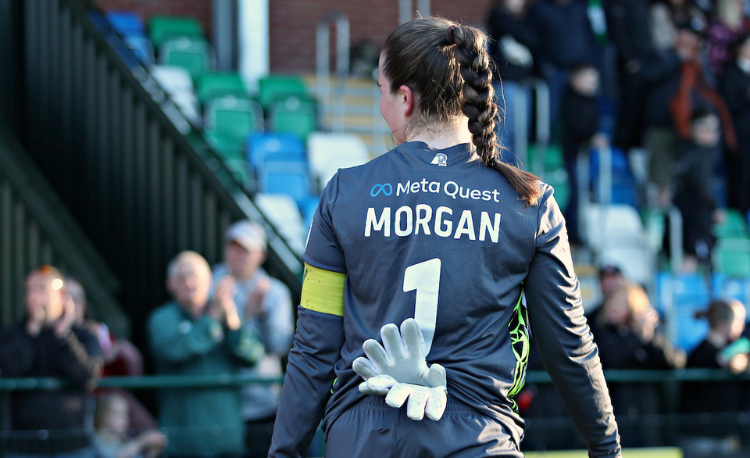
‘Help female goalkeepers adapt’
Morgan has coached men and women, and she says she does not vary her coaching much in terms of session content. Age groups, however, do require her to tweak the power of the shots the players are facing, the size of the goal they are playing in, and the area they use. She is always looking for ways to improve her coaching, describing herself as a “geek” who follows multiple goalkeeping accounts on social media.
“I saw this [social media post] a few weeks ago about how female goalkeepers have to take more steps to do that high save, that top corner save, while the men can just step and go. So the big thing for me that I’ll probably do a lot more when I’m coaching females is footwork around the goal, and getting them to move their feet quickly to activate that big take off. So that’s probably a big difference.”
She adds: “Over the years there have been a lot of people saying, ‘Oh, [women’s] goals should be smaller, but I disagree. I just think you’ve just got to find a way to help our female goalkeepers adapt, and my way of doing it is making sure they get their footwork in. If they’re not moving their feet to activate, to power through that high save, they haven’t got a chance.”
She has also noticed an increased demand for female goalkeepers to command their box and deal with crosses better as well as being comfortable with the ball at their feet.
“With that in mind, I do a lot of work on those sorts of things because I think if I can set my keepers up to be proficient and well known to be good in those areas, I’m setting them up for a good career, wherever that may be, whether that’s at Liverpool or elsewhere, because ultimately I care about them and I want them to have a good career and enjoy football, whatever that may be.”
‘Push yourself’
Morgan has also enjoyed time coaching within the Cymru national set-up, and is particularly pleased to see the talent pathway for female coaches there, although she is keen to ensure that all appointments are on merit.
“Last year all the age groups had a female head coach and a female goalkeeper coach, which is great to see. You can see what the FAW is trying to do and I like it.”
If Morgan were to give advice to any novice coaches in the women’s game, she would recommend that they get used to being out of their comfort zone, a challenge she refers to regularly.
“Be comfortable being uncomfortable,” she says. “I know the female game is getting a lot bigger, but football is still predominantly a male game. A lot of my coaching courses [were] with men; my A licence [course, there were] 60 of us and only four women. I was comfortable with that, but some people might not be as comfortable. They might be too afraid to speak out in the classroom sessions or be afraid to deliver in front of men.
“But I believe if you’re in an uncomfortable situation, you’re pushing yourself and you’re learning, and you get comfortable in those moments eventually. That’s the only way you take that next step.”

Carrie Dunn

Latest Content
Subscribe Today
Newsletter Sign Up
Subscribe Today


Newsletter Sign Up
Subscribe Today
Latest Issue
Discover the simple way to become a more effective, more successful soccer coach
In a recent survey 89% of subscribers said Women's Soccer Coaching makes them more confident, 91% said Women's Soccer Coaching makes them a more effective coach and 93% said Women's Soccer Coaching makes them more inspired.
*includes 3 coaching manuals
Get Inspired
All the latest techniques and approaches


Women's Soccer Coaching offers proven and easy to use soccer drills, coaching sessions, practice plans, small-sided games, warm-ups, training tips and advice.
We've been at the cutting edge of soccer coaching since we launched Soccer Coach Weekly in 2007, creating resources for the grassroots youth coach, following best practice from around the world and insights from the professional game.
