
 close
close


 LOGIN
LOGINYou are viewing
1 of your 3 free articles
Defending early
A three-part session working on defending early, being on the front foot to regain possession by being compact, and working within a unit.Session structure: Warm-up, Practice, Small-sided game


Warm-up
WHY USE IT
The warm-up provides a lot of repetition and builds on 1v1 defending attributes.
Set-up
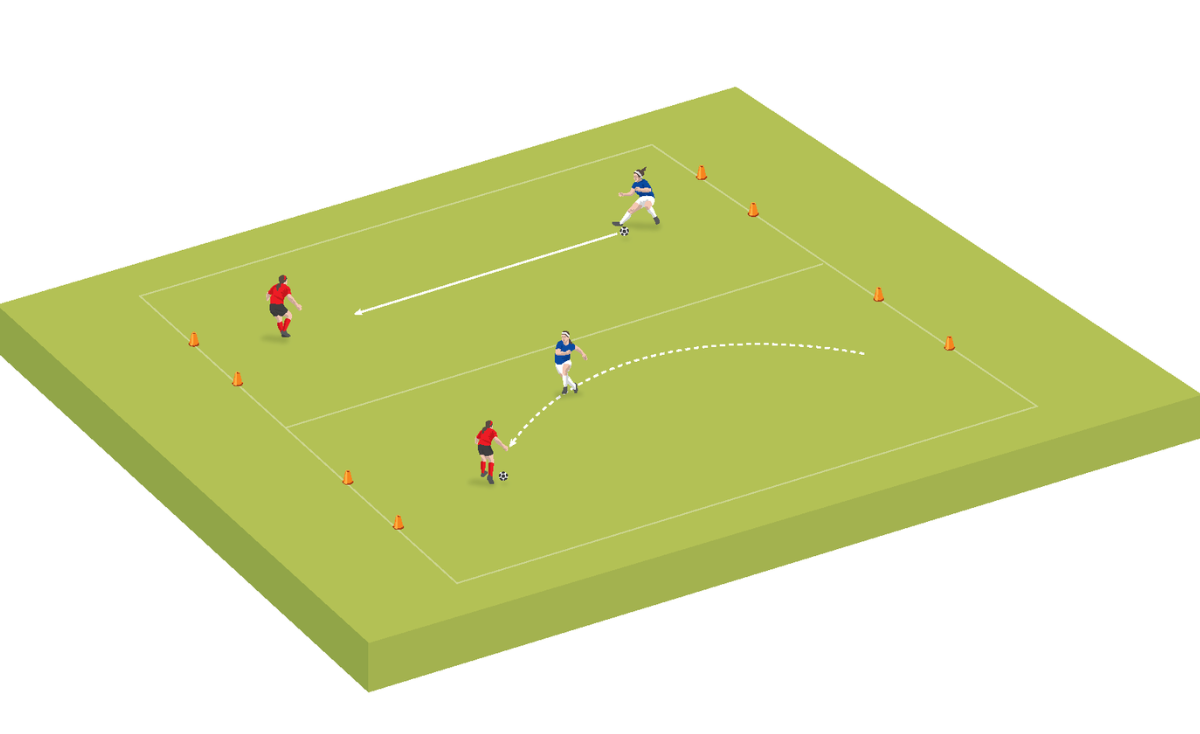
Mark out a series of equal rectangles alongside each other, relative to the age and ability of your players. You’ll need one rectangle per pair of players. Start with two players – one defender and one attacker – in each rectangle. The rectangles have gates at either end, or you can use mini goals if available.
HOW TO play
The defender starts by playing a firm, punched pass into the attacker. As soon as the attacker touches the ball, the game is live and the defender can press.
The attacker scores by dribbling the ball through the gates at the opposite end. If the defender wins the ball, they can counter-attack into the opposite gates.
progressions & ADAPTATIONS
-
Progress into a 2v2 by merging two adjacent rectangles. Start the game with two 1v1s; then, as soon as one 1v1 is over, the two groups merge. Once the 2v2 is complete, revert back to 1v1s.
COACHING POINTS
-
The defender should adopt a side-on body position, with their feet shoulder-width apart, arms’ length from the attacker, and their knees bent.
-
The defender should shut down the space quickly and then slow down when reaching the attacker. They should stay low, with knees bent, and show the attacker on the outside, to use the touchline as an additional defender.
-
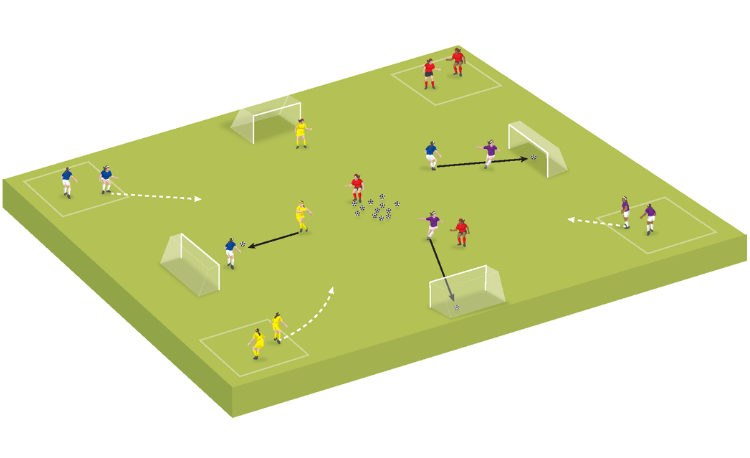
Divide players into pairs, each pair in their own channel
- One player starts as the defender and passes the ball to their opponent, the attacker
- As soon as the attacker touches the ball, the defender can press
- The attacker aims to dribble through the defender’s gate. If the defender wins possession, they can score by dribbling through the attacker’s gate
Practice
WHY USE IT
This phase-of-play practice builds on the warm-up, to create a more game-realistic scenario and start to work as a unit when defending (press, cover and balance).
Set-up
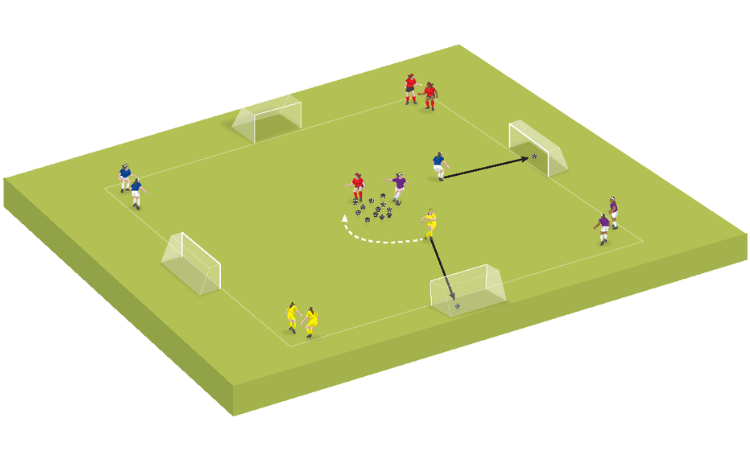
Mark out an area relative to the age and ability of your players. Place a goal centrally at one end, and two mini goals wider at the other end. Mark a line roughly three-quarters of the way up the area. The game should ideally be played as a 5v5, plus a goalkeeper.
HOW TO play
The ball will always start from the goalkeeper. Teams will swap roles every 10 balls. The team with the goalkeeper focuses on building out from the back and scoring in the mini goals – they can’t shoot until they have crossed the line. The other team aims to win possession as early and high up the pitch as possible and score in the main goal.
progressions & ADAPTATIONS
If the team building from the back is taking a lot of time to do so, add a condition where they must score within 10 seconds of the goalkeeper releasing the ball.
If the pressing team isn’t being aggressive enough with their press, challenge them to win the ball back within five seconds – any goal they score can then count double.
COACHING POINTS
- Stop forward passes. The player closest to the ball should press the opponent; the next player should provide cover; the third player provides deeper balance, ready to win a long ball or press a switch of play.
- Once the ball is regained, both teams should transition quickly to attempt to score/win possession back.
- The pressing team must work as a unit and stay compact. Make play predictable by positioning your body/press to force the ball one way.
Related Files
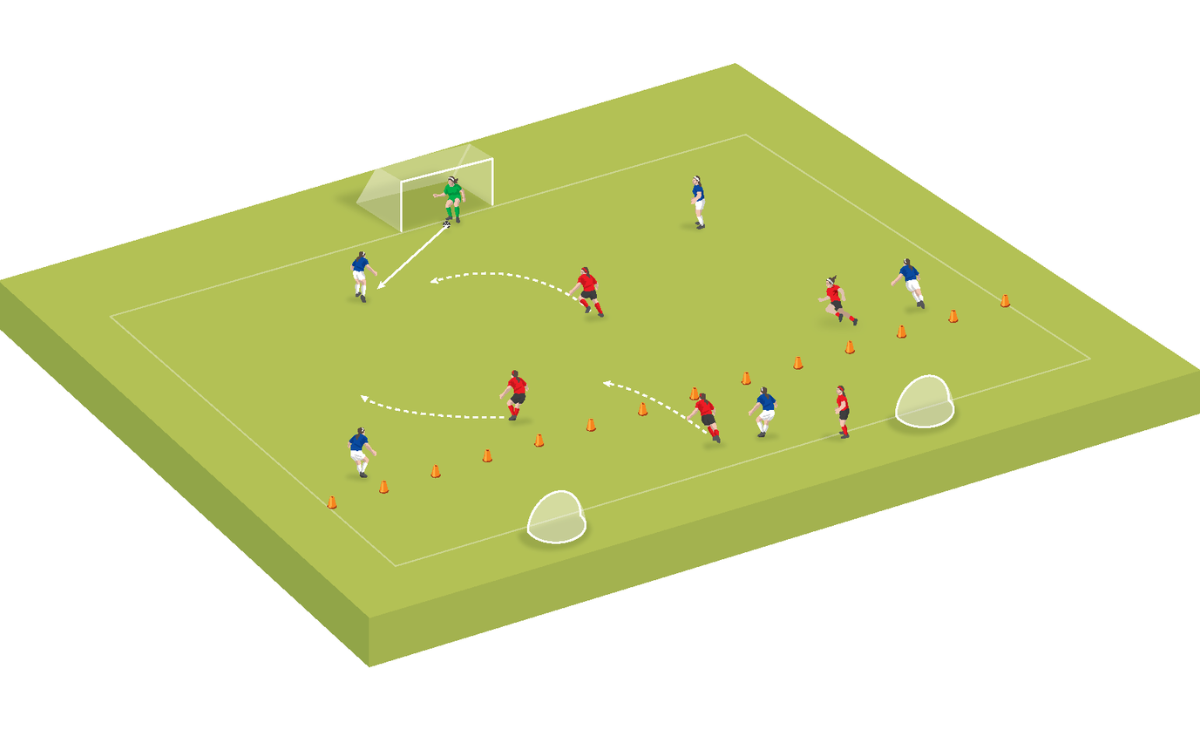
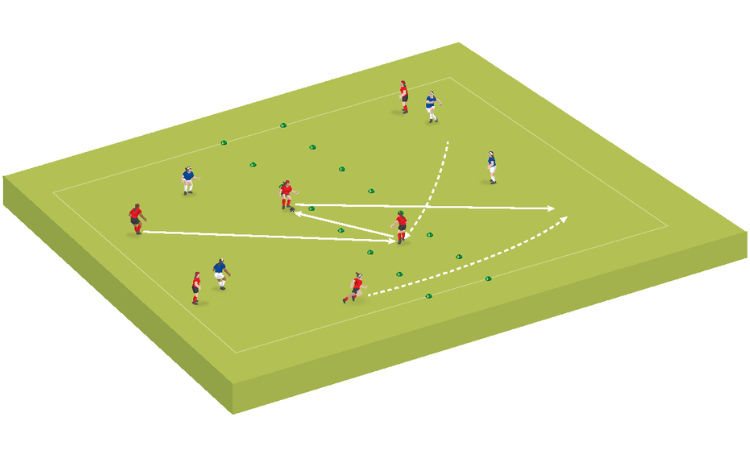
- Divide players into two equal teams, plus one goalkeeper
- Blues always start with possession from the goalkeeper and aim to cross the line of cones to score in a mini goal
- Reds aim to press as a unit and win possession high up the pitch, to score in the main goal
Small-sided game
WHY USE IT
This small-sided game enables everything developed in the session so far to be put into a game-realistic scenario, to allow for 1v1 defending, as well as defending as a unit. It also provides a number of triggers to press.
Set-up
Mark out an area relative to the age, ability and number of your players, with a goal at each end. Split it into thirds. This game can be played as a 5v5, a 6v6 or a 7v7.
HOW TO play
Normal game rules apply. However, if players win possession in the final third and score, they are awarded three goals. If they win possession in the middle third and score, they get two goals; and if they do so from their own defensive third, they get one goal.
progressions & ADAPTATIONS
Set individual targets for players as necessary – for example, higher-skilled players, or those you want to encourage to play quicker, can be limited to two touches, while others can be allowed freedom to be creative and take players on.
You can also challenge players to only play forward passes.
For more intensity, you can create a scenario where one of the teams is losing 1-0, so they have to win the ball back as early as possible to score.
COACHING POINTS
- Be aggressive with the press and spot triggers – such as if the ball is played backwards, a pass is under-hit or a player takes a poor touch.
- Move in relation to the ball: maintain good distances between the ball and player to remain compact.
- Be brave and confident when engaging in 1v1s. Once possession is regained, scan to be able to progress the ball and score quickly.
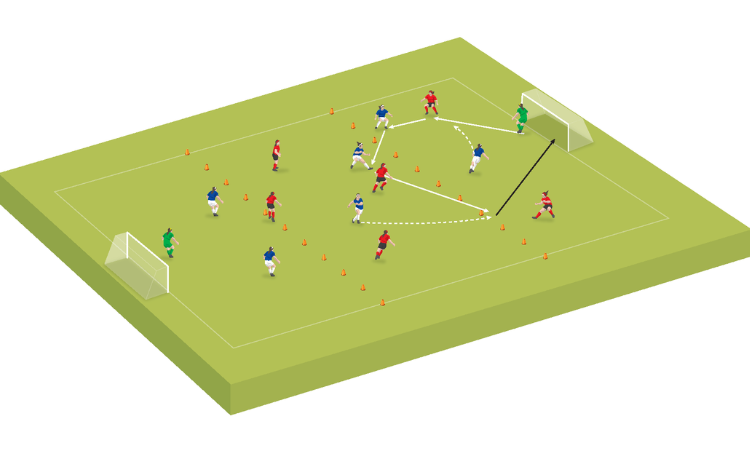
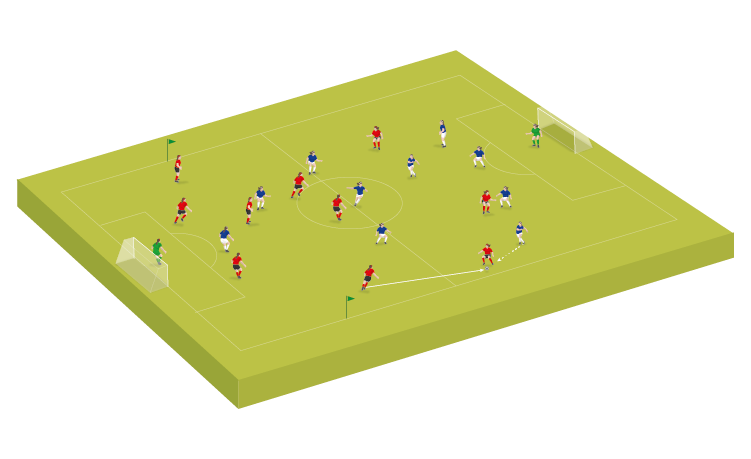
- Divide players into two equal teams and split the pitch into thirds
- If a team wins possession in the attacking third and scores, the goal is worth three
- A goal is worth two if possession is won in the middle third
Latest Content
Subscribe Today

Newsletter Sign Up
Subscribe Today
Newsletter Sign Up
Subscribe Today
Latest Issue
Discover the simple way to become a more effective, more successful soccer coach
In a recent survey 89% of subscribers said Women's Soccer Coaching makes them more confident, 91% said Women's Soccer Coaching makes them a more effective coach and 93% said Women's Soccer Coaching makes them more inspired.
*includes 3 coaching manuals
Get Inspired
All the latest techniques and approaches


Women's Soccer Coaching offers proven and easy to use soccer drills, coaching sessions, practice plans, small-sided games, warm-ups, training tips and advice.
We've been at the cutting edge of soccer coaching since we launched Soccer Coach Weekly in 2007, creating resources for the grassroots youth coach, following best practice from around the world and insights from the professional game.
