
 close
close


 LOGIN
LOGINPlaying it out
Develop players’ ability and confidence in playing out from the back while promoting problem-solving. Session structure: practice 1, practice 2, small-sided game
Why use it
This three-part session develops players’ ability and confidence in playing out from the back. It also promotes problem-solving.
Practice 1
Set up
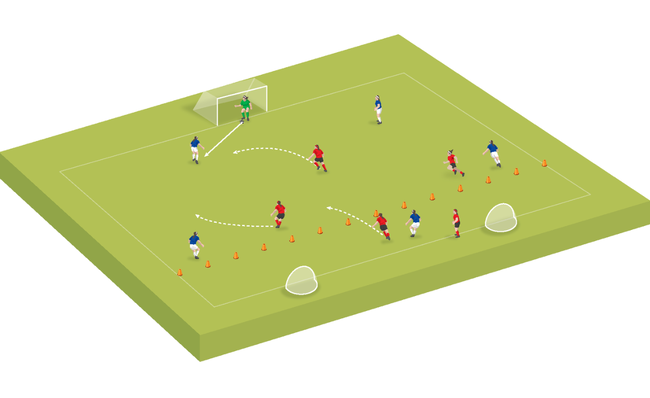
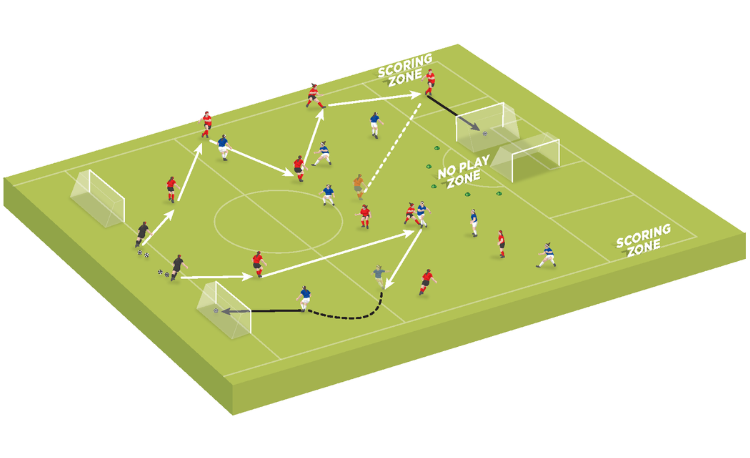
Mark out an area relative to the age, ability and number of your players. Set out a channel at each side, each with a neutral wide player in. Divide the remaining players into two equal teams. Two ‘centre backs’ start at each end, with ‘central midfielders’ in the middle of the area.
How to play
Centre backs always start with the ball. The aim is for a team to transfer possession from their centre backs to the opposition centre backs. The other team are then in possession and aim to do the same. Teams can use the neutral wide players who cannot be challenged in their channels. Centre backs also cannot be challenged.
Progressions/adaptations
Centre backs can drive forward with the ball into the main area to create an overload. You can also progress so that the wide players and centre backs can be tackled.
Coaching points
Encourage players to be patient in possession and play the pass they see. Players should scan and receive with an open body to allow them to play forward where possible. Encourage quick combination play in central areas and a switch of play via the centre-backs.
You need to be logged in to continue reading.
Please register for limited access or take a 30-day risk-free trial of Women's Soccer Coaching to experience the full benefits of a subscription.

Women's Soccer Coaching

Latest Content
Subscribe Today

Newsletter Sign Up
Subscribe Today
Newsletter Sign Up
Subscribe Today
Latest Issue

Discover the simple way to become a more effective, more successful soccer coach
In a recent survey 89% of subscribers said Women's Soccer Coaching makes them more confident, 91% said Women's Soccer Coaching makes them a more effective coach and 93% said Women's Soccer Coaching makes them more inspired.
*includes 3 coaching manuals
Get Inspired
All the latest techniques and approaches


Women's Soccer Coaching offers proven and easy to use soccer drills, coaching sessions, practice plans, small-sided games, warm-ups, training tips and advice.
We've been at the cutting edge of soccer coaching since we launched Soccer Coach Weekly in 2007, creating resources for the grassroots youth coach, following best practice from around the world and insights from the professional game.
