
 close
close


 LOGIN
LOGINYou are viewing
1 of your 3 free articles
Build, control and create
Train players to build through, around or over the press, with the emphasis on movement off the ball in this three-part session. Session structure: practice 1, practice 2, small-sided game.


WHY USE IT
This session aims to help players become comfortable building the play, equipping them with options to build through, around or over the press and emphasising the importance of movement off the ball and problem solving.
Practice 1
Set up
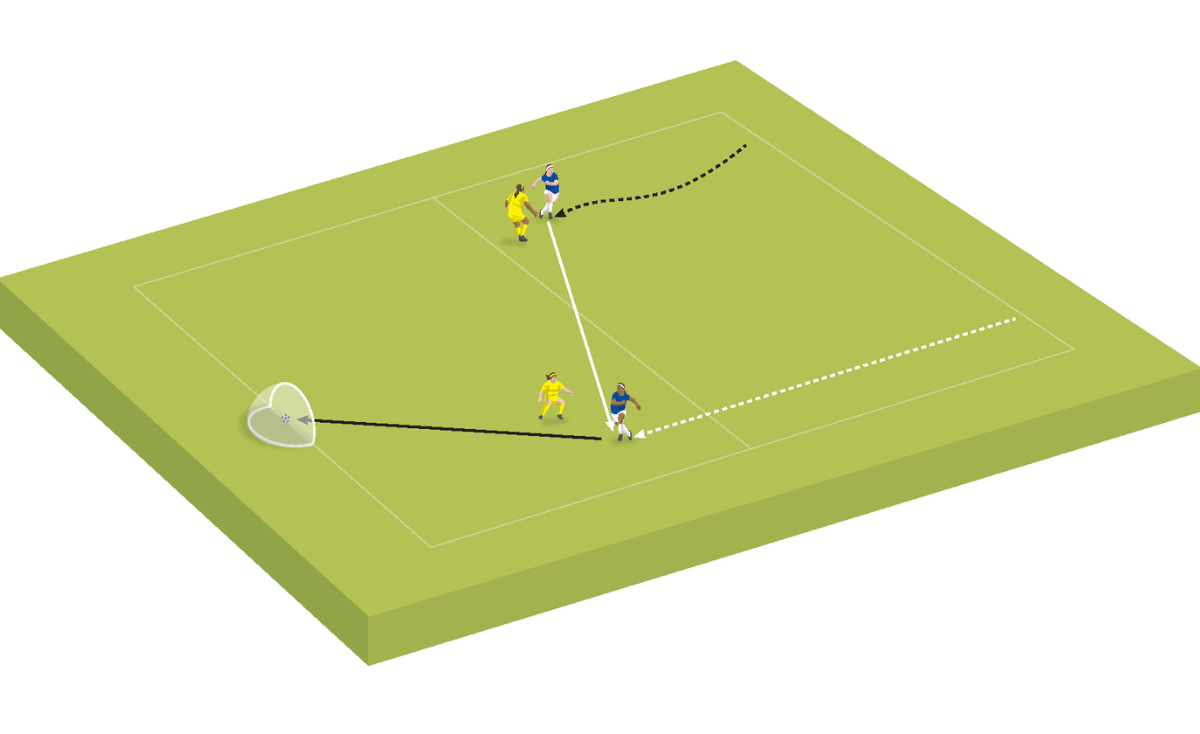
Set up an area relevant to the number and ability of players. Two gates are placed halfway along the area, out to the sides. Two equal teams (Blues and Reds) start on opposite sides of the area - these teams work together to retain and switch the play.
Another team (Whites) act as defenders, while Yellows are neutral players. Two Yellows are placed outside the area at opposite ends.
How to play
In-possession teams (Blues and Reds) aim to pass through gates, or via the central Yellow player, to retain and switch possession. Every transfer into the opposite half is worth one point.
If the Whites win the ball back, they can play to Yellows for a point. Play restarts from Yellows. Work for one and a half minutes, then swap the pressing team.
Technique
Encourage players to adopt the correct body shape (half-turn) to allow them to receive to play forwards. Players should aim to play off one or two touches and look to make movement in behind and in between the lines.
Also encourage players to be positive and play penetrating passes. In possession, teams should make the area big and show courage and composure.
Progression
Players can now dribble through gates to break the lines. Encourage movement to still have four players in each half when in possession.
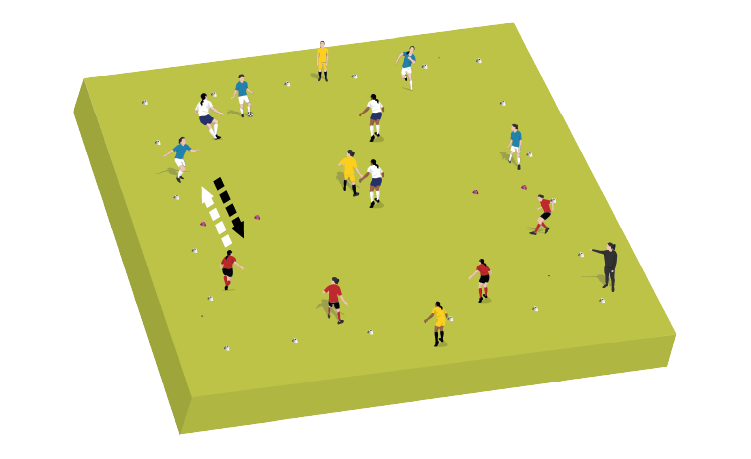
- Set up a playing area with two gates halfway down the pitch
- Two teams (Blues and Reds), plus neutral players (Yellows), aim to retain and switch possession away from defenders (Whites) by playing through gates or using central Yellow player
- If the defenders (Whites) win possession, they can score a point by playing to the neutral players (Yellows). Play then continues with Yellows playing to the in-possession teams (Reds and Blues)
- Progress the practice by allowing players to dribble through the gates as well as pass through. Encourage movement to keep equal numbers on each side of the playing area
Practice 2
Set up
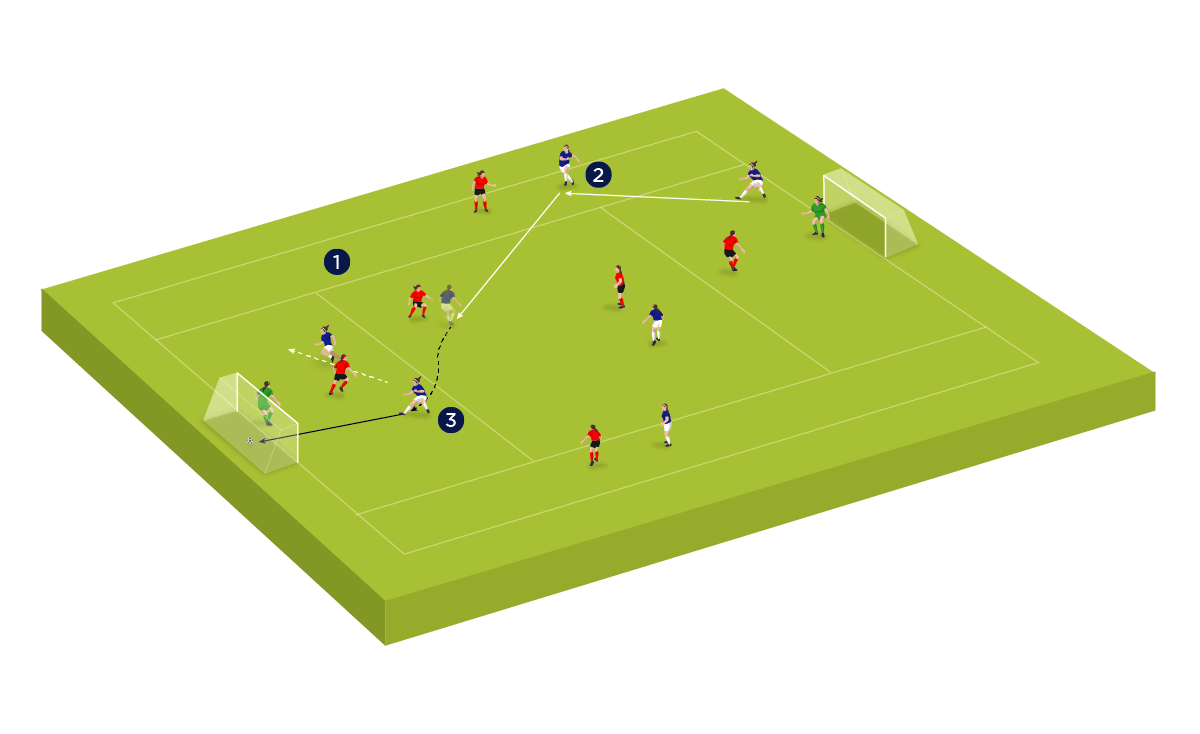
Set up using the full width of the pitch, with a second goal placed around the edge of the centre circle, depending on number and ability of players. Split the pitch into quarters. Depending on numbers, set teams up with 7v4 or 7v5 outfield players, plus a goalkeeper in each goal.
How to play
Playing from alternate ends, the goalkeeper plays into the centre-back before the press can start. Once the Reds break the lines (in this instance by going over the halfway line), the Blues can’t make recovery runs into the other half. The Reds must have a shot on goal within five seconds of breaking over the halfway line.
The movement of players off the ball dictates the pass options, to full-back, central midfielder or striker. The different starting positions of defenders also dictate attacking options:
A. Yellow option: Goalkeeper –> centre-back –> full-back (drive) –> striker (finish)
B. Blue option: Goalkeeper –> centre-back –> striker-> central midfielder (finish)
C. Red option: Goalkeeper –> centre-back –> central midfielder –> full-back (drive and finish).
The central midfielder works in both directions, acting as a number 10 when attacking.
Technique
Encourage players to adopt the correct body shape (half-turn) to allow them to receive to play forwards. Players should aim to play off one or two touches and look to break the lines quickly.
Encourage players to problem solve to create overloads (e.g. 3-v-2 + goalkeeper in build phase) and show courage and composure in possession.
Progression
One defender can recover into the attacking half.
Related Files
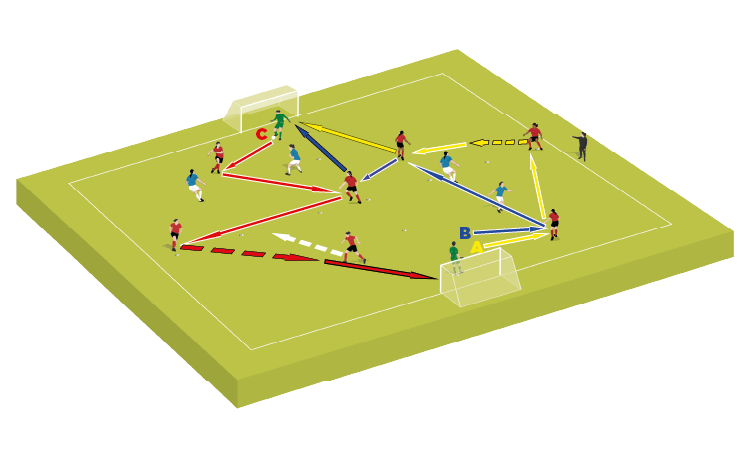
- Divide the playing area into quarters
- Reds (in possession) work on three patterns to build the play, under pressure from defenders (Blues)
- Progress the practice to allow one defender to recover into the attacking half
Small-sided game
Set up
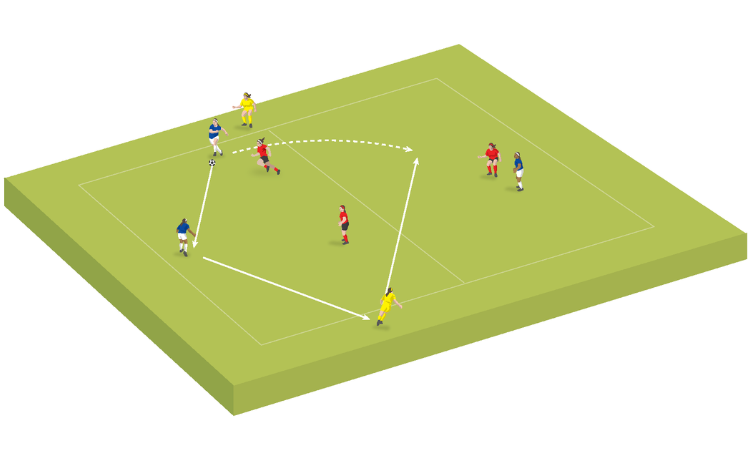
Set up using the full width of the pitch, with a second full-size goal placed around the edge of the centre circle (depending on number and ability of players) and two mini goals placed out wide, in line with this full-size goal. Set up with the team attacking the full-size goal and two mini goals (Reds) having an overload (e.g. 6 v 5), with a goalkeeper in each main goal.
How to play
Play starts with the Reds’ goalkeeper, to build the play. Look for the team in possession to create a quick build-up, in order to break the lines and split the units to score into small goals, or the full-size goal in the middle.
Teams get two points for scoring in the full-size goals and one point for scoring in the mini goals. If the Blues win possession, they attack the opposite goal.
Players need to problem solve, develop intelligent movement off the ball by using the space in the wide areas and use the build-up options from the previous practice.
Technique
Encourage players to adopt the correct body shape (half-turn) to allow them to receive to play forwards.
Players should aim to play off one or two touches and look to break the lines quickly. Encourage players to problem solve to create overloads and show courage and composure in possession.
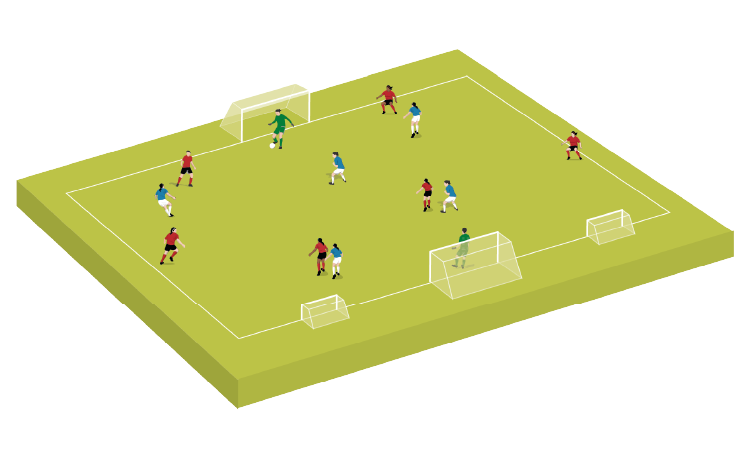
- Using the full width of the pitch, set up a playing area with a full-size goal at each end and two mini goals at one end
- Reds work to build the play, with an overload of one player e.g 6 v 5. Each team plays with a goalkeeper
- Reds can score in the full-size goal (2 points) or the mini goals (1 point). If Blues win possession, they can attack the opposite goal, earning 2 points if they score

Niamh Russell

Latest Content

Subscribe Today

Newsletter Sign Up
Subscribe Today
Newsletter Sign Up
Subscribe Today
Latest Issue

Discover the simple way to become a more effective, more successful soccer coach
In a recent survey 89% of subscribers said Women's Soccer Coaching makes them more confident, 91% said Women's Soccer Coaching makes them a more effective coach and 93% said Women's Soccer Coaching makes them more inspired.
*includes 3 coaching manuals
Get Inspired
All the latest techniques and approaches


Women's Soccer Coaching offers proven and easy to use soccer drills, coaching sessions, practice plans, small-sided games, warm-ups, training tips and advice.
We've been at the cutting edge of soccer coaching since we launched Soccer Coach Weekly in 2007, creating resources for the grassroots youth coach, following best practice from around the world and insights from the professional game.
