
 close
close


 LOGIN
LOGINYou are viewing
1 of your 3 free articles
Aggressive pressing
This three-part session teaches the principles of a high press and trains the desire to commit to one. Session structure: three practices.


Practice 1
WHY USE IT
This exercise trains the impulse to press aggressively and collectively to win possession in the attacking third.
Set up
Set up an area relative to the age, ability and number of players. Place two poles or cones at halfway and mark out a square at either end. Divide players into three equal teams, placing one in each of the two squares and the third evenly placed behind both poles.
How to play
The coach passes into a square. Two defenders from the pressing team (shown here in Blue, one from each pole) sprint into the square to press and create a 6v2 rondo.
The objective of both in-possession teams (Yellows and Reds) is to keep possession for a minimum of four passes and switch to the opposite square. The objective of the pressing team (Blue) is to score three points.
The pressing team scores a point each time they clear the ball from the square. Play continues with a new ball being fed into the opposite square and two new Blues pressing.
The pressing team scores three points if they win possession and switch play to the opposite square.
Play continues with the team losing possession transitioning from attack to defence, while the Blues transition from defence to attack and occupy the free square. The pressing team continues until they have scored three points.
Progressions
You may need to modify the playing area to allow for the pressing team to succeed. It should be possible for them to press aggressively and collect three points within 4-6 actions.
This keeps the exercise at a high-intensity, ultra-competitive and with multiple transitions within the two minutes.
Coaching points
Pressing team
- Be physically aggressive but mentally composed
- Sprint with intention to break up possession within 2-3 passes; no jockeying
- 100% intensity
- Work together, be prepared to combine to beat initial counter-press and make switching pass for three points
In-possession teams
- Quality of pass: appropriate weight, accuracy and ball speed to move defenders
- Open body position, scanning and awareness of defenders
- Use an up-back-through to set ball for a player facing forward to make switch pass
- Be prepared for transition to defence: anticipate turnover, close space and cut off passing lane to opposite square. Win back possession as quickly as possible and retain the ball.
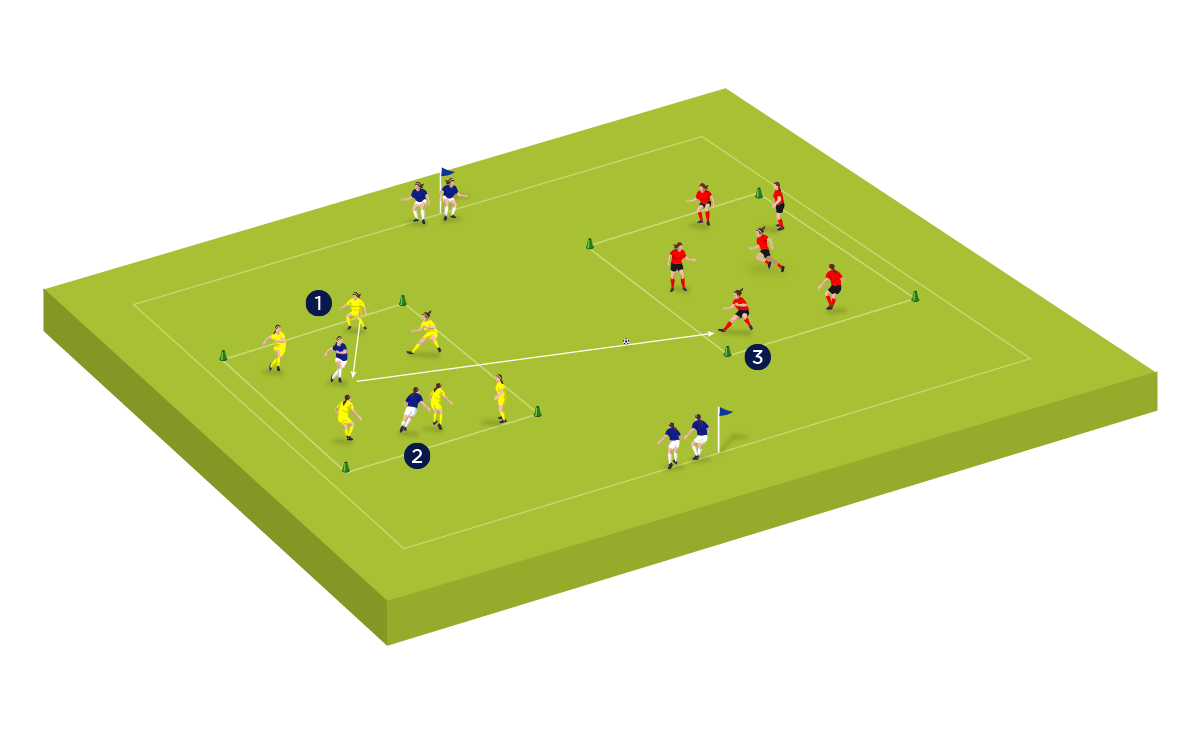
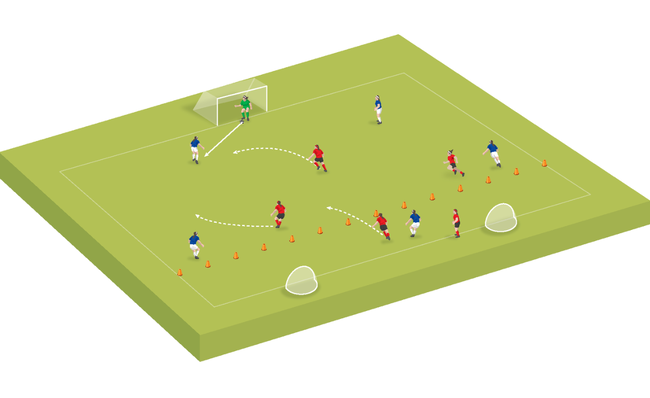
- Two teams start in their respective areas. The coach plays a ball into one team
- Two defenders run into the area to try to get the ball out of the area for a point
- Defenders get three points if they win possession and can switch play to the other team
Practice 2
Why use it
This exercise is position-specific and can be adapted to train high pressing in any system. Players transfer the concepts from Practice 1 into a phase of play.
Set up
Set up three mini goals across the halfway line as targets for the attackers.
Put a supply of balls in the goal and with the coach.
How to play
Play begins with a goal-kick. The attacking team’s objective is to score in the mini goals or to dribble over the halfway line.
The defending team’s objective is to press high, win possession and score.
Progressions
Vary the starting point of the exercise. Begin with a throw-in or the coach can play a deep pass in behind the defence to simulate a turnover from the Reds.
Coaching points
Defending team (Reds)
- Establish starting point to press: who, when, where and how. Yellow attackers are set-up in a 1-4-3-3 (three forwards omitted) and the Red pressing team in a 1-4-4-2 (goalkeeper and back four omitted).
- Starting positions of the two strikers are directly in front of the centre-backs, to make a straight run once the first pass is played.
- As pressing team is underloaded, players must be prepared to press at least two players. Here, the right-sided striker must press the left centre-back and the left full-back, who is in a low starting position, making the distance too far for the right midfielder to press. The left-sided striker comes over to be in position to cut off the pass to the right centre-back, and press the goalkeeper or the left centre-back if the full-back plays a return pass.
- Four midfielders are positioned far enough from their direct opponent to give impression they can receive a pass, but close enough to press the receiver’s first touch or prevent a turn. They must also be prepared to sprint across to press a second attacker.
- If the attacking team breaks the press, the Reds must drop to cover the mini goals or prevent a dribble over the halfway line.
- Counter-attack directly following transition. Show awareness to play penetrating passes and finish effectively.
Attacking team (Yellows)
- Quality of pass: Appropriate weight, accuracy and ball speed
- Open body position, scanning and awareness of pressing players
- Find spare player. Use goalkeeper to switch play and utilize numerical superiority.
- Create space by coming short to make deep runs in behind or long to come short
- Be prepared for the transition to defence – anticipate the turnover, close the space and cut off forward passing lanes. Win possession as quickly as possible or drop into a low block to protect the goal.
Related Files
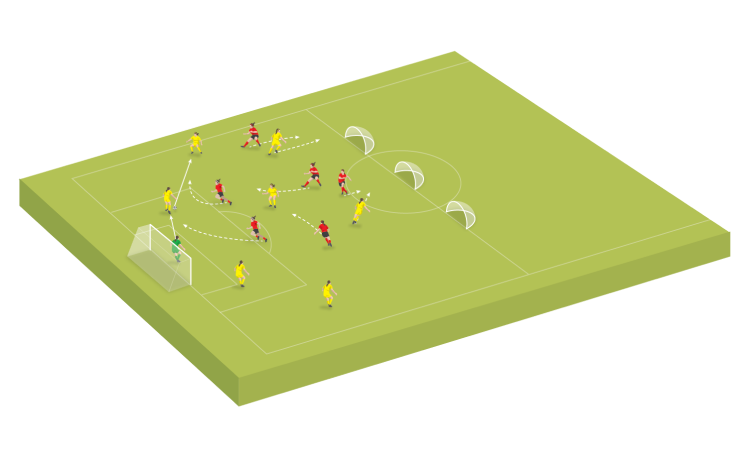
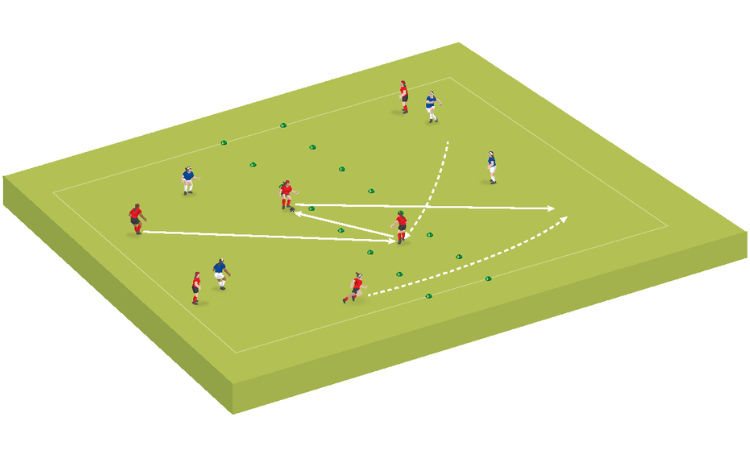
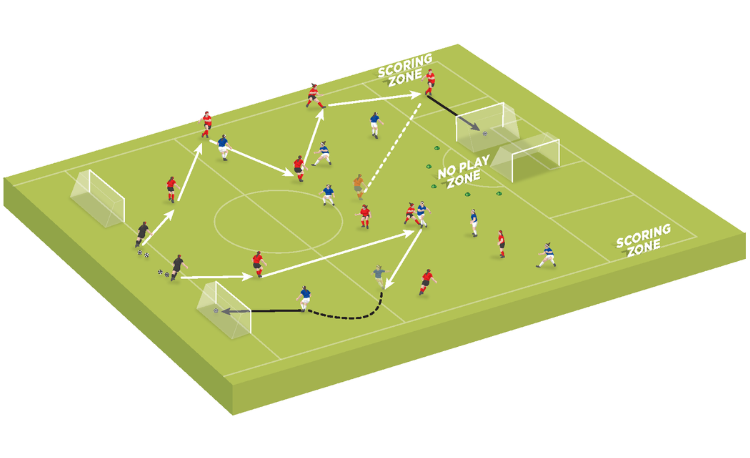
- Set up with two teams. The in-possession team (Yellows) start with a goal kick and aim to play out and score in a mini-goal
- Out-of-possession team (Reds) work together to press high, win possession and score in the main goal
Practice 3
Why use it
This activity simulates what can happen if a high press is unsuccessful. Players are committed in advanced positions and the defensive line may be outnumbered and need to drop and delay the attack to allow time for the midfielders to make recovery sprints.
Set up
Place three mannequins 6m from the halfway line; one central and one on each flank. Place three markers 12m from the halfway line in front of the mannequins.
Have a supply of balls at each mannequin and use an assistant coach to monitor offsides.
How to play
The Reds’ right full-back starts with the ball at the wide mannequin. The Yellow attacking midfielder starts at the marker 6m in front of the mannequin.
The Red defender passes to the Yellow midfielder and immediately sprints to get goal-side. This creates a temporary 4v3 attacking situation for the Yellows and encourages them to play quickly to exploit the overload and finish the attack.
Aim for each action to last no longer than 6-10 seconds and stop once the forward momentum of the attack is halted.
The objective is to train the recognition and reaction to an underload situation in defence and the importance of recovery sprints.
The coach can act as a target for the Reds once they regain possession. This trains the transition for both teams.
Progressions
Change the point of attack to the centre and opposite flank.
Coaching points
Defending team (Reds)
-
Defend compact and collectively
-
Drop when there is no pressure on the ball, step up when there is pressure on the ball
-
Protect centre and show to the sidelines
-
Mark players close to the ball and mark space further from the ball
-
Track and recover to fill space behind ball
-
Transition from zonal to player-marking in defensive third
-
Transition to attack: Play first pass forward to coach or play back to goalkeeper.
Attacking team (Yellows)
-
Play forward as precise as possible and as fast as necessary
-
Create as much space as possible to receive
-
Take as few touches as possible
-
Use space behind opponent before they drop
-
Be aggressive and ruthless around the goal
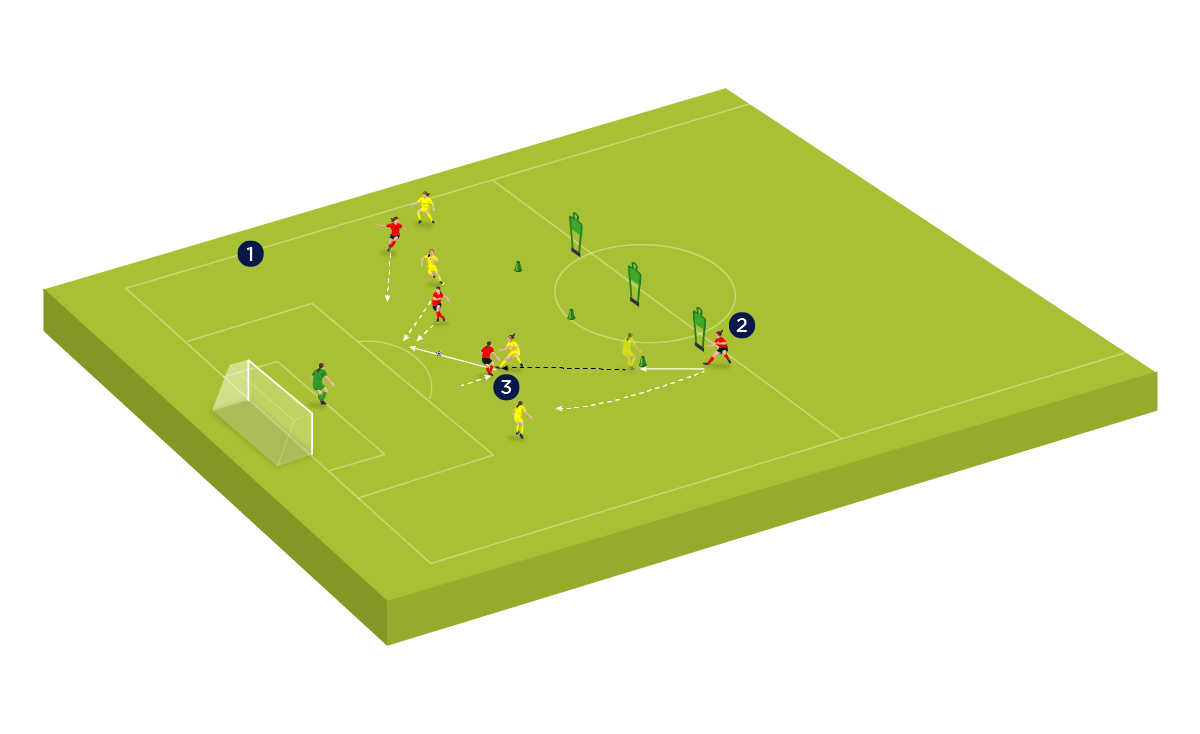
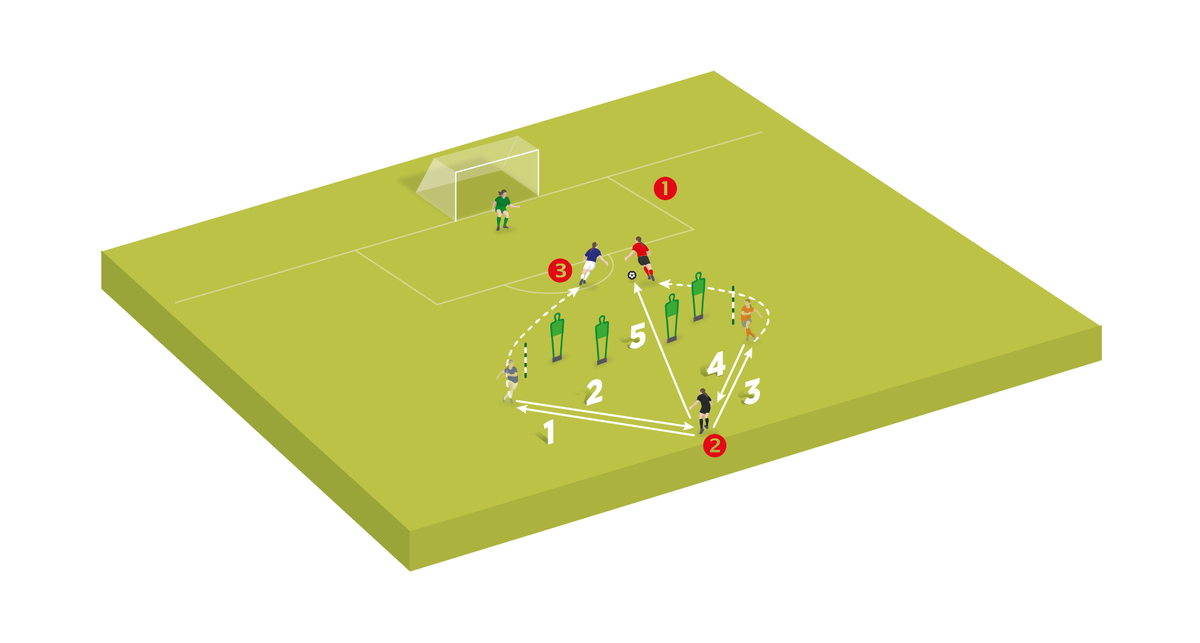
- Set up with two teams
- Reds’ full-back starts by passing to a Yellow midfielder, before making a recovery run
- Reds aim to delay the attack to regain a 4v4 situation. If they win possession, they can play to the coach, aim to hit a mannequin or dribble beyond the halfway line

Matt Ross
Latest Content

Subscribe Today

Newsletter Sign Up
Subscribe Today
Newsletter Sign Up
Subscribe Today
Latest Issue

Discover the simple way to become a more effective, more successful soccer coach
In a recent survey 89% of subscribers said Women's Soccer Coaching makes them more confident, 91% said Women's Soccer Coaching makes them a more effective coach and 93% said Women's Soccer Coaching makes them more inspired.
*includes 3 coaching manuals
Get Inspired
All the latest techniques and approaches


Women's Soccer Coaching offers proven and easy to use soccer drills, coaching sessions, practice plans, small-sided games, warm-ups, training tips and advice.
We've been at the cutting edge of soccer coaching since we launched Soccer Coach Weekly in 2007, creating resources for the grassroots youth coach, following best practice from around the world and insights from the professional game.
