
 close
close


 LOGIN
LOGINYou are viewing
1 of your 3 free articles
Overloads in wide areas
A three-part session which develops players’ awareness and ability to identify and exploit space in wide areas through creating overloads. Session structure: Warm-up, Practice, Small-sided game


Warm-up
WHY USE IT
This warm-up introduces players to the principles around creating overloads in wide areas, allowing them to identify and exploit opportunities and, ultimately, create goalscoring opportunities via full-backs and wide midfielders and forwards.
SET-UP
Mark out a playing area relative to the age and ability of your players. The area should be split into thirds, with additional end zones.
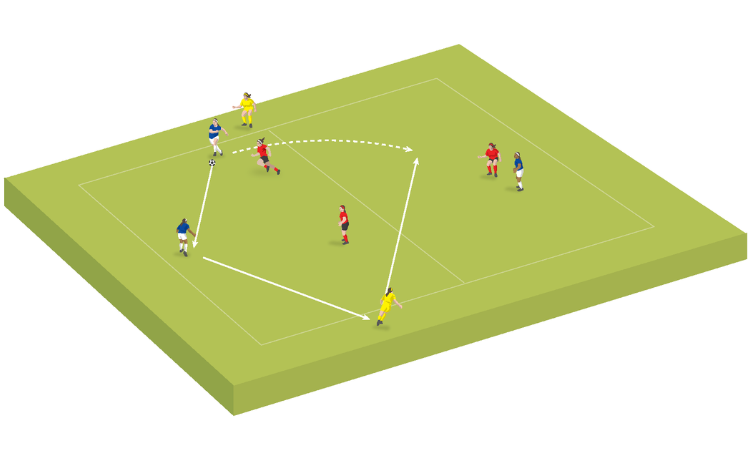
Separate players into two teams of four. Teams should set up 2v1 in their defensive third, 1v1 in the middle third and 1v2 in their attacking third.
HOW TO DO IT
Teams aim to score by dribbling into, or receiving the ball inside, the opposition’s end zone.
Players must start in their allocated third but are allowed to rotate - however, they must always have at least one player occupying each third to provide defensive balance.
The coach starts the practice by passing the ball into a team’s defensive third.
TECHNIQUE
Players should look to create space (width and depth) by drawing defenders away to create space for others, playing between the lines and progressing into space with the ball to draw the opposition towards them.
Coaches can also work on players’ movement; pinning or locking their opponent, disguising runs, making advanced forward runs from deep, and making third-man runs.
Players should also be encouraged to make the safest furthest forward pass whenever possible and work on up-back-through passing patterns to penetrate the defence.
ADAPTATIONS
The coach can make the area bigger or smaller to increase or decrease the challenge. The number of players in each third can also be increased to enhance realism.
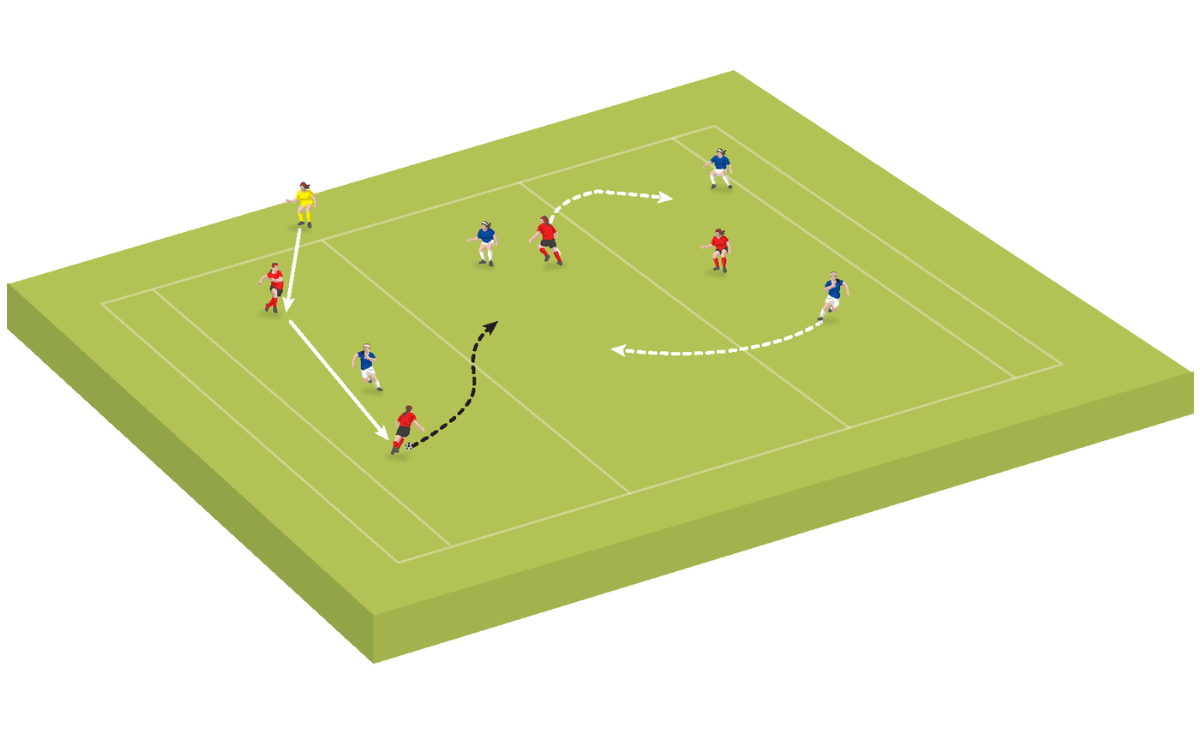
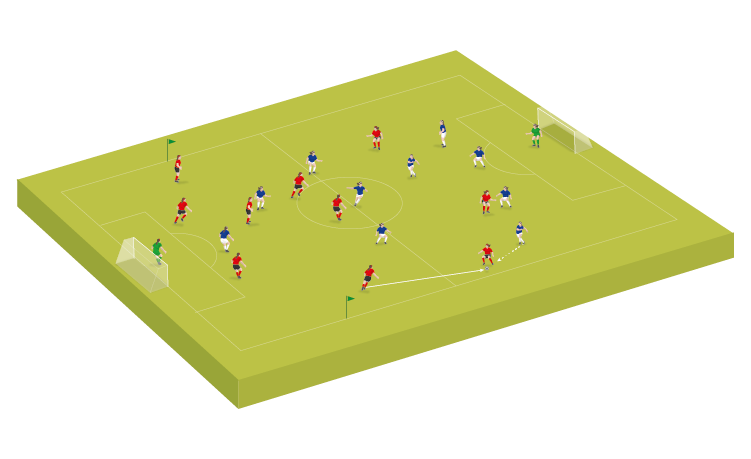
1. Split players into two teams and divide the playing area into thirds, with two unoccupied end zones
2. Teams line up 2v1 in their defensive third and 1v1 in the middle third
3. Teams aim to build through the thirds before scoring by receiving the ball in, or dribbling into, the opposition’s end zone
Practice
WHY USE IT
This mirrored function practice develops the ideas introduced in the warm-up in a more game-realistic set-up, working in relevant areas of the pitch with key players.
SET-UP
Use just over half a pitch. Place two mini-goals within the penalty area, facing outwards towards the touchlines. Place two more just over the halfway line, facing the rest of the playing area.
Mark out target zones between the edge of the penalty box and the touchlines, the end of which also acts as an offside line. A ‘no-play zone’ should also be marked out on the edge of the penalty area.
The left side of the area mirrors the right, so two groups can play simultaneously (5v3 in favour of the attacking team). Two central midfielders (one attacking and one defending) play centrally across both groups.
HOW TO DO IT
Left and right sides play simultaneously. The coach plays the ball in to the deepest player for the attacking team (a centre-back) to start the practice. Coaches can set a limit on the number of touches this player can have.
The attacking teams look to play forward, break into the target zone and score in the mini-goal (replicating a cross). If the defending teams win possession, they can counter attack and try to score in the mini-goal just beyond the halfway line.
TECHNIQUE
Players should look to create space (width and depth), work on their movement off the ball to exploit space and overload opportunities, and be encouraged to identify and execute openings to penetrate the defence.
ADAPTATIONS
The coach can add a number 9 for the defending team, who can press either centre-back on the attacking teams when the coach plays the ball in.
Players can also be challenged to man-mark, to increase the problems for the attacking teams, while a time limit can be placed on the attacking teams to score once they have broken into the target zone. Goalkeepers can be added.
Related Files
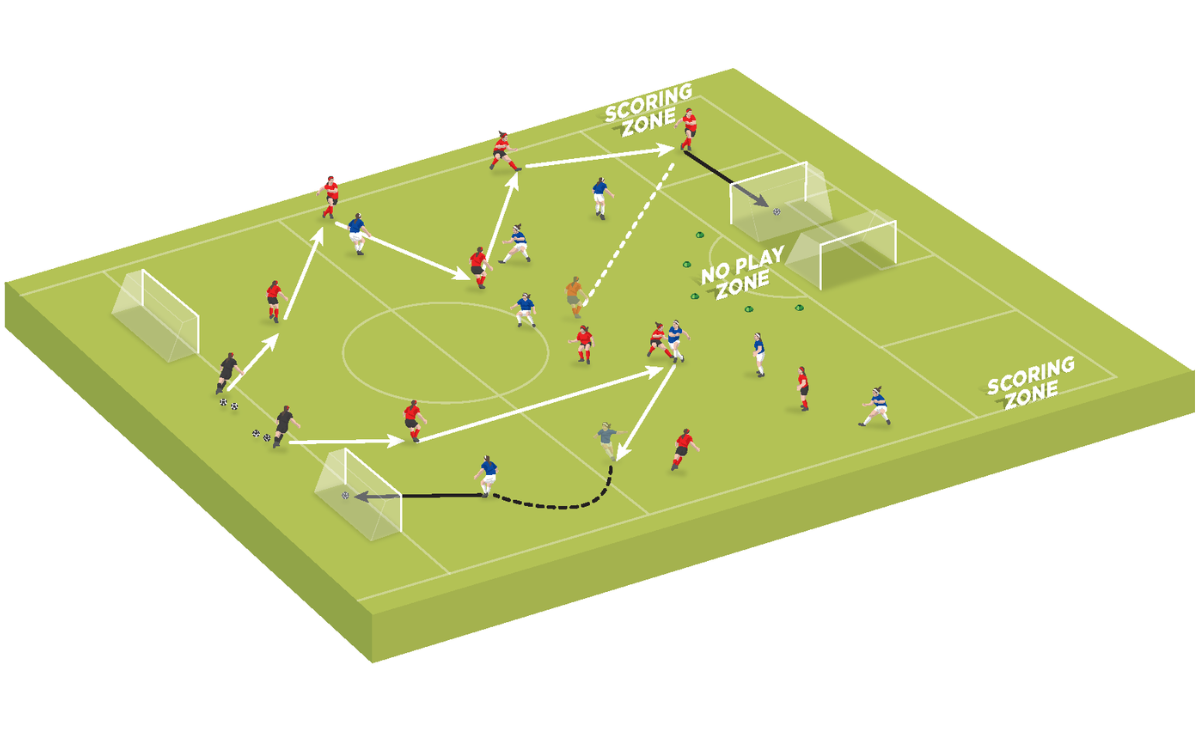
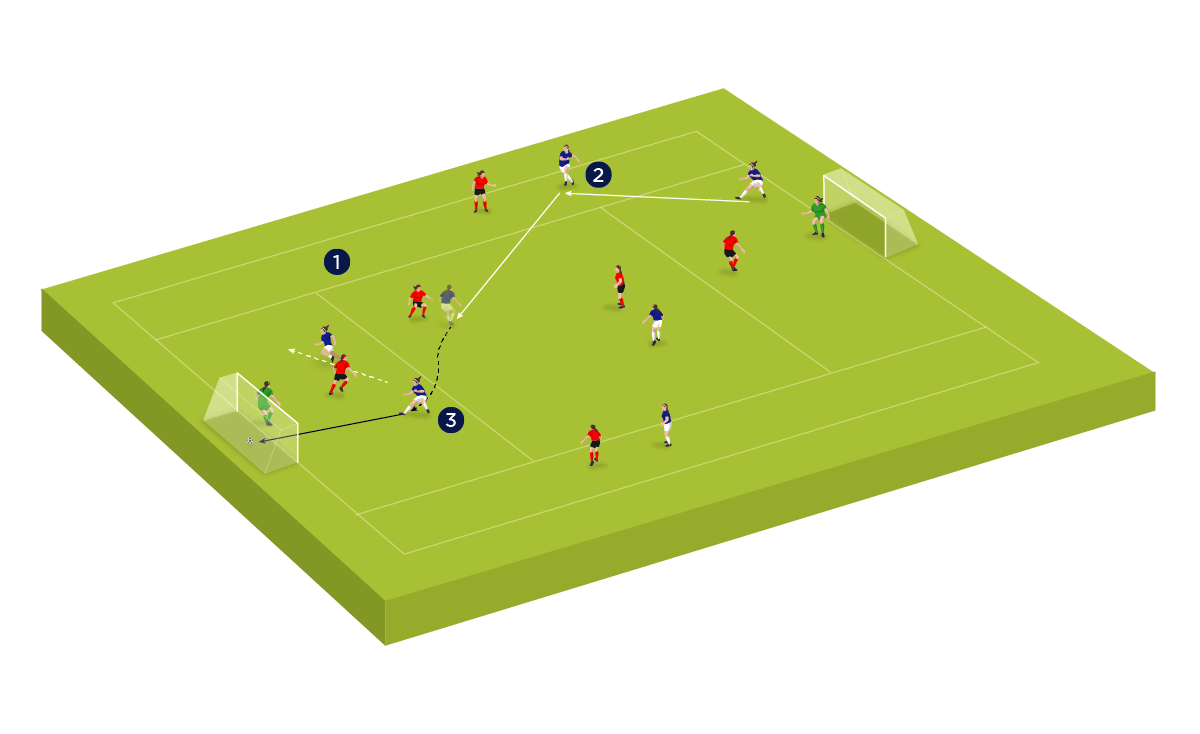
1. Set up a mirrored practice, so teams are doing the same activity on the left and right sides of the pitch
2. Both practices require teams to set up 5v3 in favour of the attacking team, with two central midfielders (one attacking, one defending) who play across both pitches
3. Coaches play the ball in and the attacking team looks to get into the target/scoring zone to score in the mini-goal
4. If the defending team wins possession, they can counter-attack and score in the mini-goal at the bottom of the pitch
Small-sided game
WHY USE IT
This phase-of-play small-sided game allows players to put the movement and passing patterns worked on in the previous practice into a more game-realistic environment.
SET-UP
Use just over half a pitch. Place a full-sized goal on the goal-line and two mini-goals just over the halfway line, facing the rest of the playing area.
The ‘no-play zone’ should remain in place from the previous practice. Three goalkeepers can play in this game, while outfield players should be split into 10-v-8 in favour of the attacking team.
HOW TO DO IT
The game is now played with one ball and opens up into a phase of play. Teams cannot attack through the ‘no-play zone’.
The attacking team has a number 9 who is allowed in the penalty box as a target player, but other attackers cannot progress beyond the offside line until the ball does. The defending team looks to attack the two mini-goals when they win possession.
TECHNIQUE
Players should look to create space (width and depth), work on their movement off the ball to exploit space and overload opportunities, and be encouraged to identify and execute openings to penetrate the defence.
ADAPTATIONS
The coach can remove the ‘no-play zone’ and add centre-backs for the defending team, so the game becomes 10v10.
The offside line can also be moved to increase or decrease the challenge for the attacking team and ensure the defending team are not killing space unrealistically.
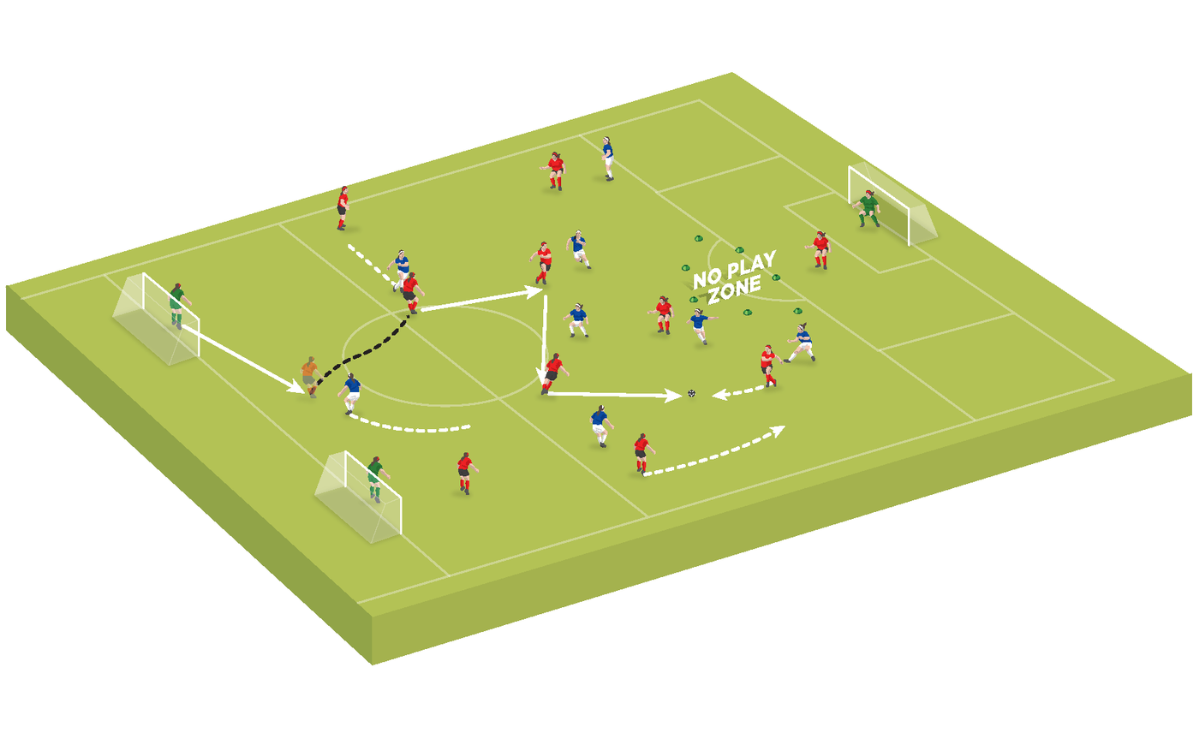
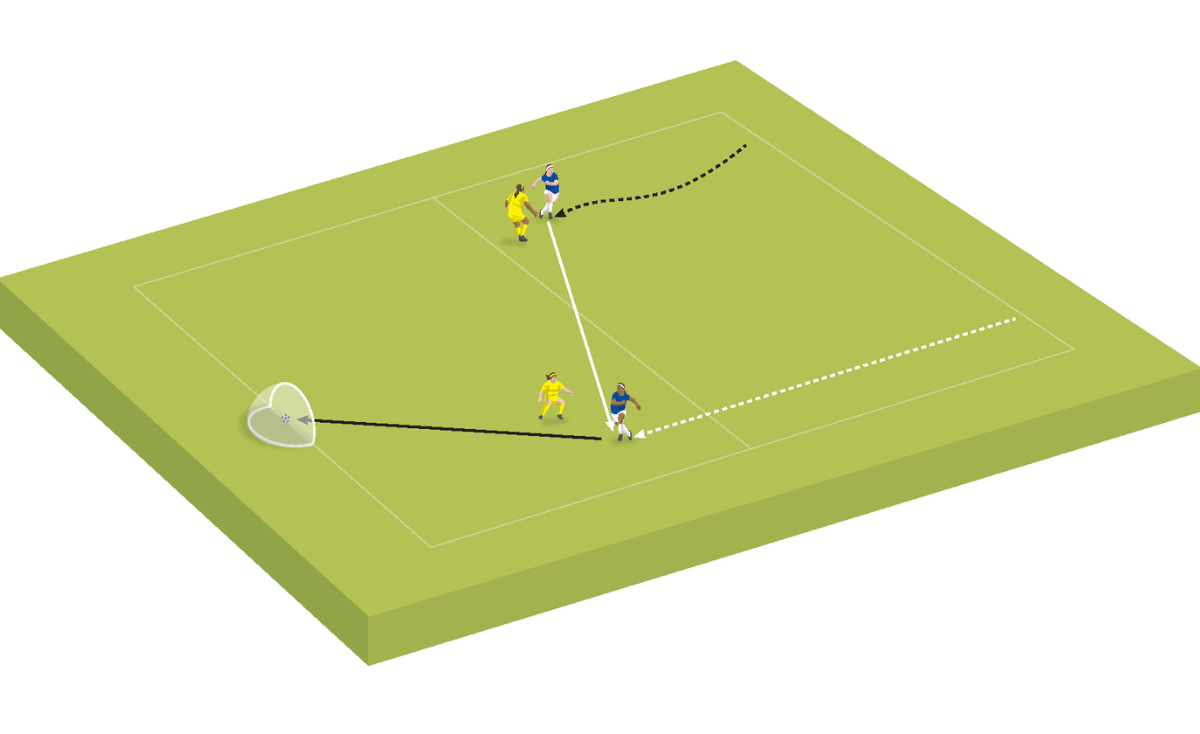
1. The previous practice area can be used, but with teams now combined to play across the whole area
2. The attacking team now looks to score in a full-sized goal
3. Only the attacking team’s number 9 is allowed in the penalty box before the ball enters. Other players can join as the ball enters the area
Latest Content
Subscribe Today

Newsletter Sign Up
Subscribe Today
Newsletter Sign Up
Subscribe Today
Latest Issue

Discover the simple way to become a more effective, more successful soccer coach
In a recent survey 89% of subscribers said Women's Soccer Coaching makes them more confident, 91% said Women's Soccer Coaching makes them a more effective coach and 93% said Women's Soccer Coaching makes them more inspired.
*includes 3 coaching manuals
Get Inspired
All the latest techniques and approaches


Women's Soccer Coaching offers proven and easy to use soccer drills, coaching sessions, practice plans, small-sided games, warm-ups, training tips and advice.
We've been at the cutting edge of soccer coaching since we launched Soccer Coach Weekly in 2007, creating resources for the grassroots youth coach, following best practice from around the world and insights from the professional game.
