
 close
close


 LOGIN
LOGINYou are viewing
1 of your 3 free articles
Movement off the ball
A three-part session which develops players’ awareness of moving off the ball to support play, create angles and make intelligent runs. Session structure: Warm-up, Practice, Small-sided game


Warm-up
WHY USE IT
This is a fun warm-up, getting players moving while getting as much contact as possible on the ball early in the session.
SET-UP
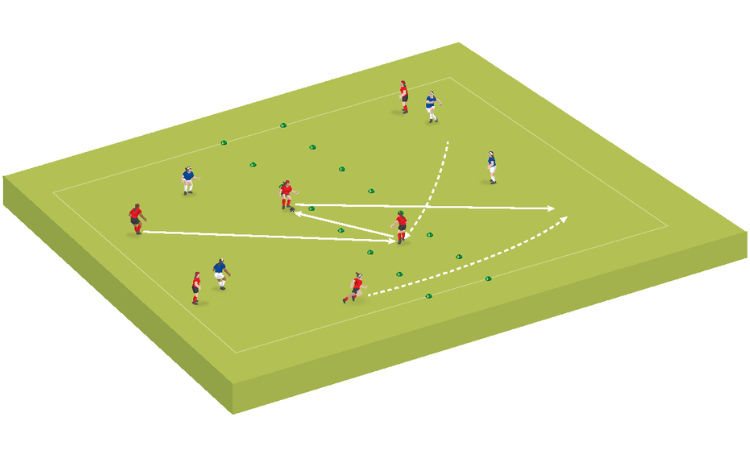
This practice requires five cones and four players, though can be extended to six cones and five players. Place four cones to form a square, with one in the middle. If possible, use tall/dome cones as this focuses movement around the cone as well as providing an obstacle, forcing the passer to focus on the direction of the pass.
HOW TO DO IT
Three players start on different outside cones, one starts on the middle cone. With no restrictions on the number of touches, players pass and then move to the cone which is free. One player must remain in the middle - so if you pass into the middle, you are following the pass (as seen in the diagram). The pass then has to be to a player who is available and ready to receive. The practice can be progressed to one-touch after a few minutes to improve the speed of the game and players’ concentration on the next pass.
TECHNIQUE
Encourage players to think ahead, concentrating on where the next pass needs to go, before they receive the ball. This will help them adopt the best body shape to play a good quality pass at speed, or take a first touch in the direction they intend the pass to go. Also, encourage passers to play the ball to the foot of the receiver which will be most helpful for them to complete their next pass. Weight of pass is also important in this practice, while quick movement off the ball is pivotal to success.
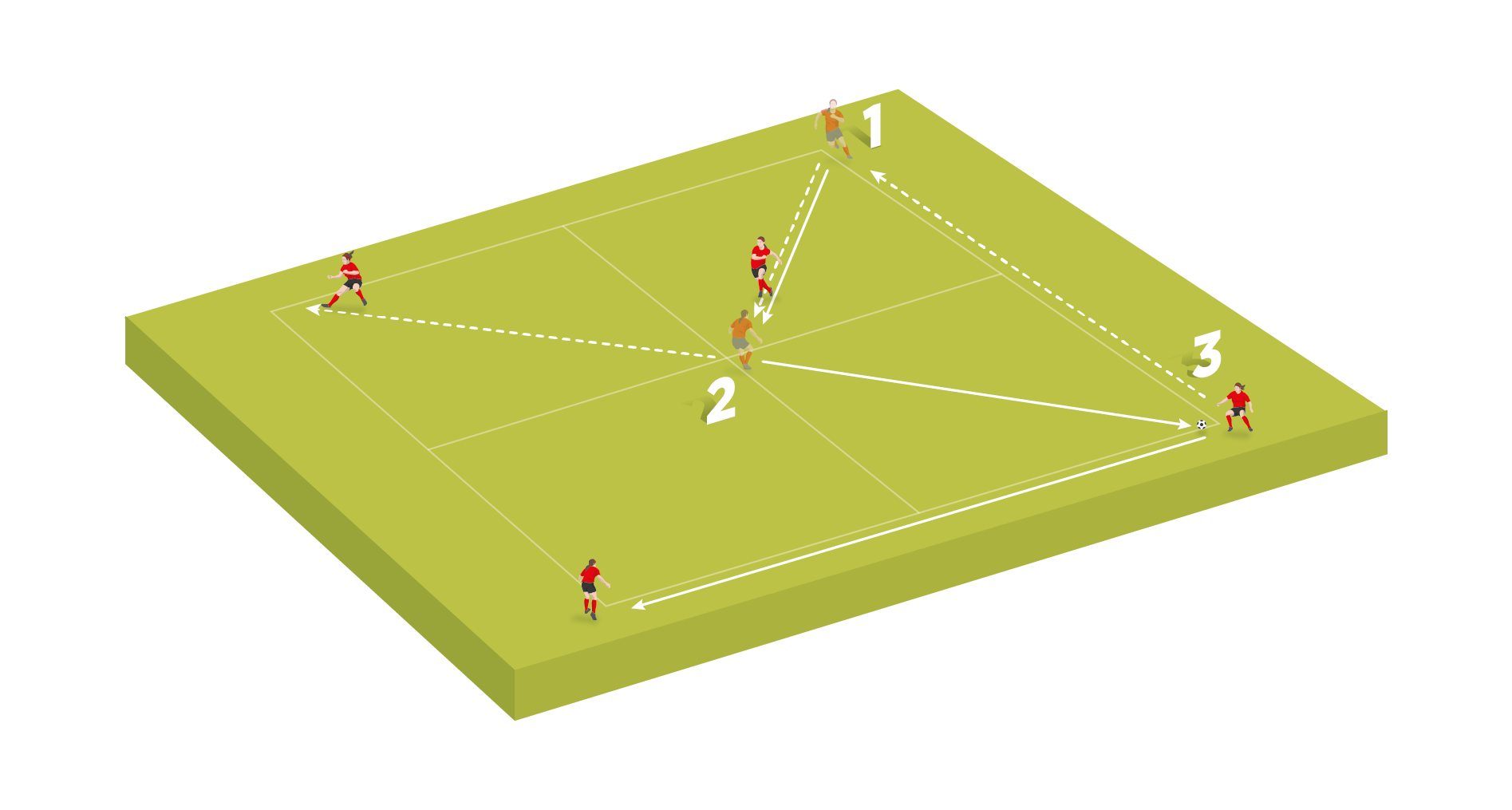
- Set up a square playing area with three players starting in separate corners and one starting in the middle. Play starts with an outside player passing to the middle player and following.
- From here, the player passing the ball always looks to move to the spare cone after their pass has been made. One player must always be occupying the middle cone.
- To advance the practice, you can progress to one-touch play.
Practice
WHY USE IT
This practice gets players’ feet on the ball as well as encouraging quality and timing of movement off the ball.
SET-UP
Set up poles as the start-point markers for the defender (blue) and attacker (red) just outside of the 18-yard box and place mannequins as obstacles in-between the two poles. Use a full-size goal.
HOW TO DO IT
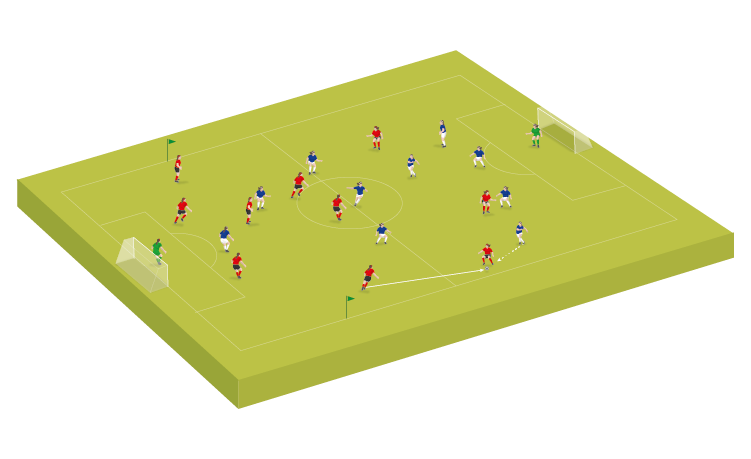
Three players - one attacker, one defender, one server - set up outside the 18-yard box. The server starts with the ball. You can also use a goalkeeper if available. The server plays a one-two with the defender (blue) before playing a one-two with the attacker (red). The server then plays a through-ball for the attacker to run onto and try to score. As soon as the ball is played, the defender must also react and get into position to defend 1-v-1 and prevent a shot on goal.
TECHNIQUE
This practice gets players on their toes and focuses them on providing a good weight of pass, adopting a good body shape, as well as developing an explosive movement once the through-ball is played. Encourage players to curve their run to stay onside and work on feints, double-feints and other movements to deceive defenders. The server can also work on disguising their through-ball with a no-look pass, using the outside of the foot or deceiving with their body shape.
ADAPTATIONS
This practice can be switched up in a few different ways, such as altering the number of passes before the through-ball is played. For example, another one-two could be played with the defender, or the through-ball could be played immediately after the first one-two, ensuring players remain on their toes and focused on their movement. Players can also work off different starting positions, or work on different combinations to create an opening. For example, the attacker could peel wide to receive, creating space for the server to drive between the mannequins and shoot themselves.
Related Files
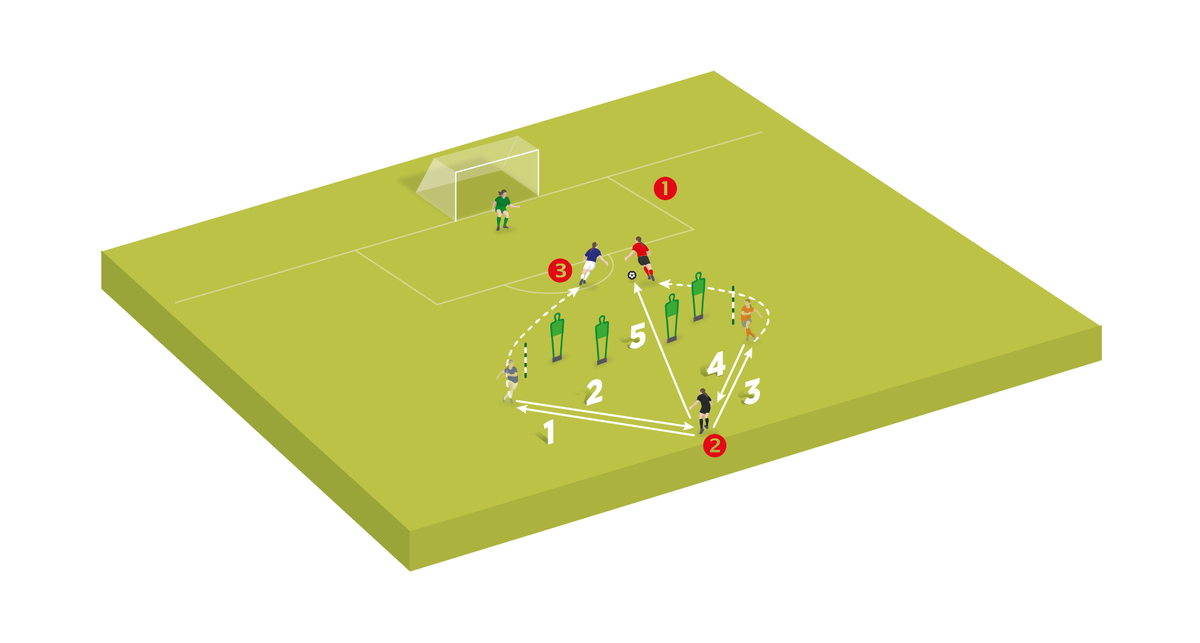
- Set up using half a pitch, with a server (black), defender (blue), attacker (red) and a goalkeeper.
- The server starts with the ball and plays a one-two with the defender, before playing a one-two with the attacker.
- The attacker then makes a forward run to receive a through-ball from the server, while the defender makes a recovery run for a 1-v-1 situation to goal.
Small-sided game
WHY USE IT
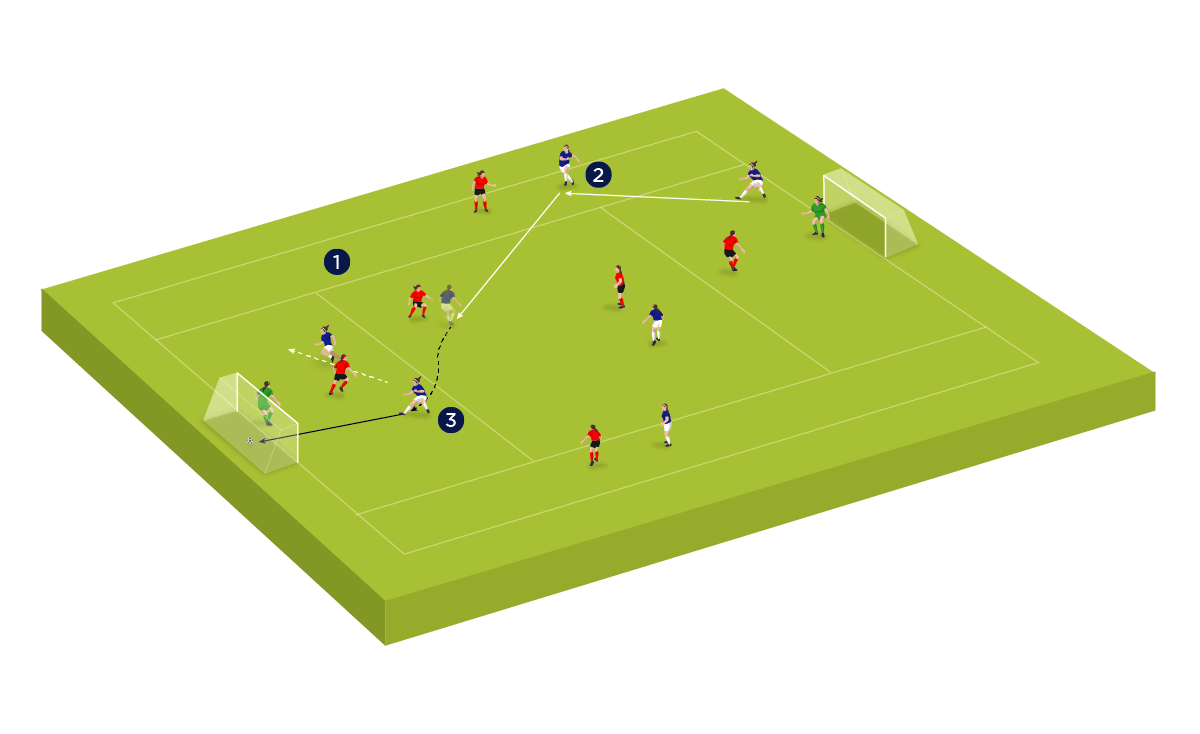
This small-sided game builds on the previous practice and is based around awareness of team-mates’ positions, positions of opponents and moving across the field together as a team.
SET-UP
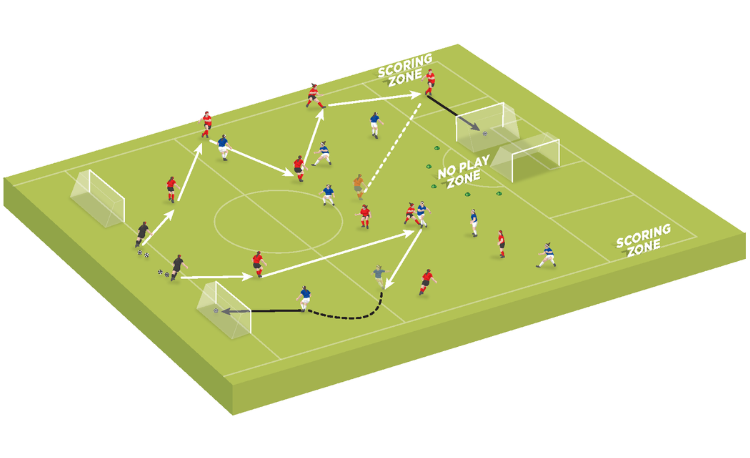
Set-up using half a pitch, split into six zones, with a small goal in each corner. Play with two teams of 5-v-5, with each team having three defenders and two attackers.
HOW TO DO IT
It is a two-touch game, requiring players to move together to score goals. A player can only score from within the same zone as the goal they are scoring into. The three defenders should stay within two of the three defensive zones at any one time. So, in the above image, if the blues’ right-sided defender were to move into the vacant zone, the left-sided defender would need to be aware to move into the central defensive area. The two attacking players must also stay in different attacking areas. Players cannot dribble the ball into a different area, so passing and movement off the ball are important.
TECHNIQUE
Encourage players to consider when to move as a team and to work on different types of movement to deceive defenders, support in possession team-mates and create overloads. Passing skills are also developed in this practice, with weight of pass, passing to feet or into space and passing to the front or back foot all important to success.
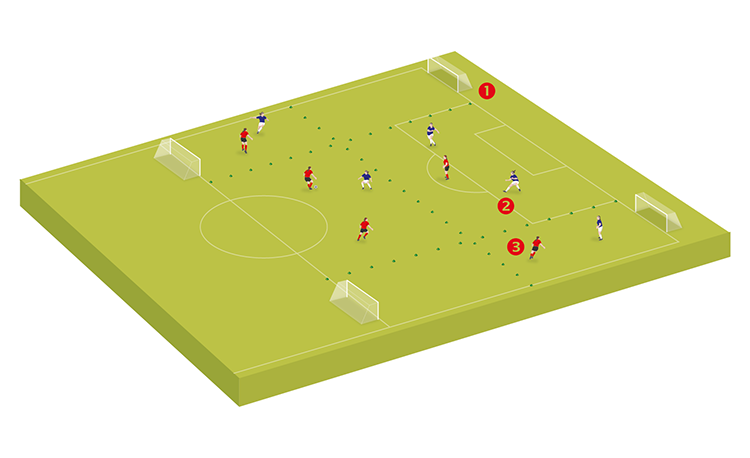
- Set up a playing area with a mini goal in each corner and the area divided into six zones, as shown. Players are split into two equal teams of three defenders and two attackers.
- Playing two-touch, with no dribbling between zones, players must move together as a unit. Defenders can only occupy two of the three defensive zones at any one time, while attackers must also be in adjacent zones.
- Attackers can only score in the goal that is situated within the same zone they are occupying.
Latest Content
Subscribe Today

Newsletter Sign Up
Subscribe Today
Newsletter Sign Up
Subscribe Today
Latest Issue

Discover the simple way to become a more effective, more successful soccer coach
In a recent survey 89% of subscribers said Women's Soccer Coaching makes them more confident, 91% said Women's Soccer Coaching makes them a more effective coach and 93% said Women's Soccer Coaching makes them more inspired.
*includes 3 coaching manuals
Get Inspired
All the latest techniques and approaches


Women's Soccer Coaching offers proven and easy to use soccer drills, coaching sessions, practice plans, small-sided games, warm-ups, training tips and advice.
We've been at the cutting edge of soccer coaching since we launched Soccer Coach Weekly in 2007, creating resources for the grassroots youth coach, following best practice from around the world and insights from the professional game.
