
 close
close


 LOGIN
LOGINYou are viewing
1 of your 3 free articles
When to pass
A three-part session to develop your players’ decision-making around releasing the ball. Session structure: warm-up, practice 1, practice 2


WHY USE IT
Develop your players decision-making around when to release the ball.
Warm-up
WHY USE IT
This warm-up enables players to gain confidence and competence at drawing the defender close to them before releasing the pass.
Set-up
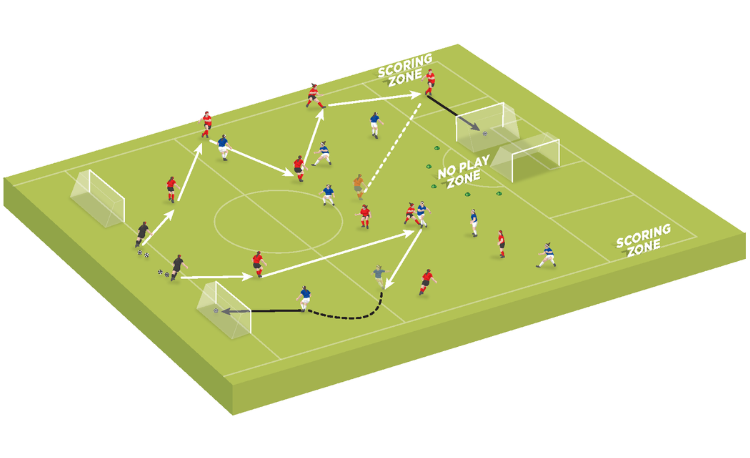
Mark out a suitably sized area, appropriate to the number of players, their age and ability. The area can be of any shape. Players are arranged in groups of three.
HOW TO play
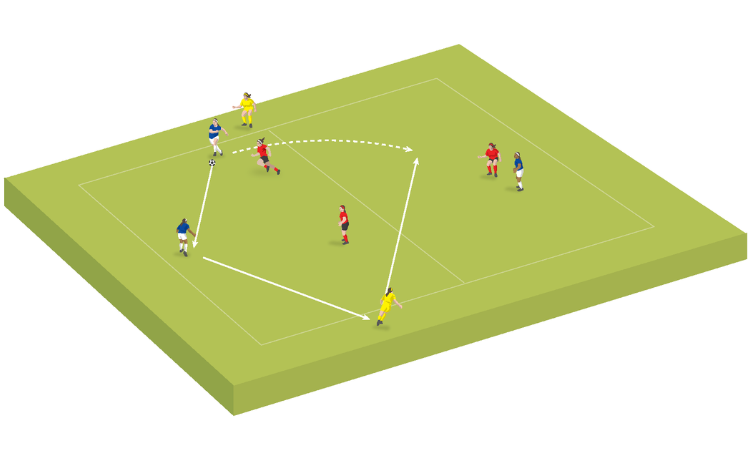
Two attackers keep possession against one defender, and try to make as many passes as possible in the time limit.
The defender earns three points if they can win possession of the ball and dribble out of the area.
Play rounds of 30-45 seconds to ensure the enthusiasm and pressure from the defending player is high.
progressions & ADAPTATIONS
-
Divide the area in half or quarters and challenge the attackers to visit each section.
-
Place mini goals on the outside of the area, and cone gates within it. The attacking team needs to dribble through a gate before attempting to score in the goal furthest away.
COACHING POINTS
Encourage players to:
-
Scan to see the positioning of their team-mate.
-
Get close to the fire without getting burned (draw the defender in before releasing the ball to a team-mate in space).
-
Communicate with your pass – this should tell the receiver what to do (e.g. a pass played slightly in front of them encourages them to play forward).
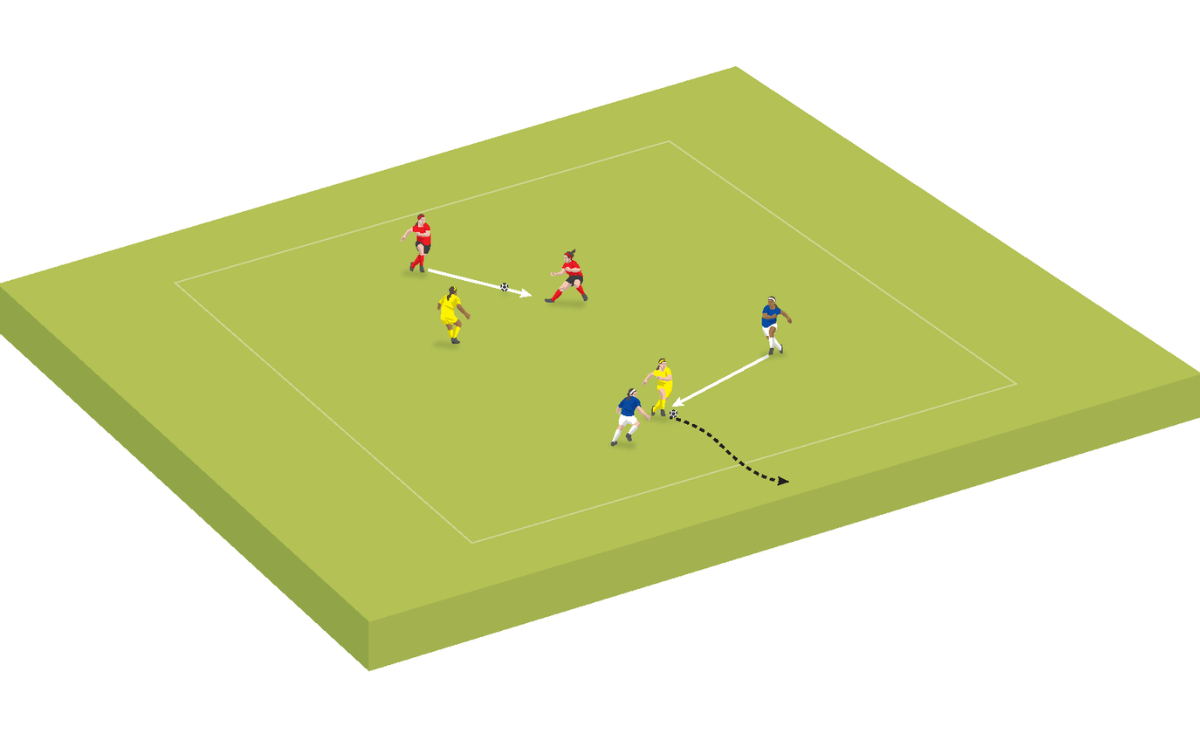
-
Divide players into groups of three. Each group should have two attackers and a defender
-
Attackers aim to complete as many successful passes as possible within the time limit
-
Defenders earn a point if they win possession and dribble out of the area
WHY USE IT
This practice allows players to enhance their understanding of when to pass the ball.
Set-up
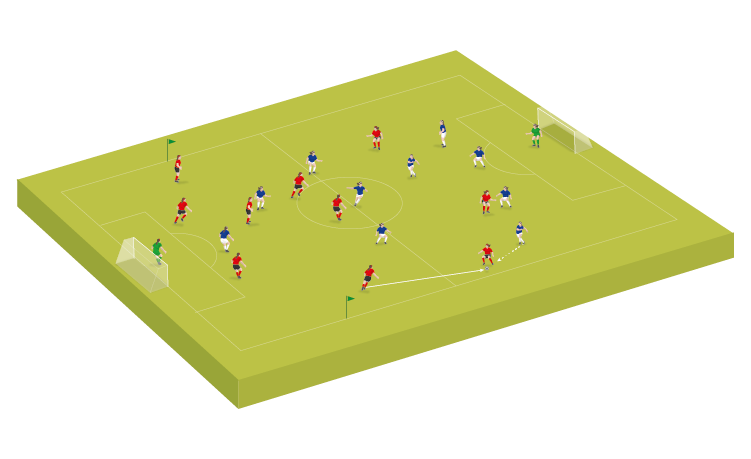
Mark out a suitably sized area, appropriate to your players’ age and ability. Divide it into two equal horizontal halves, with a mini goal at one end. Arrange players into groups of four. Mark out a pitch for each group.
HOW TO play
Split the groups of four into two attackers and two defenders. The attacking team starts at the end furthest from the mini goal. A player from the defending team is locked in each half of the area.
The attacking team has to progress over the halfway line before they can shoot at the mini goal. The defending team must win the ball back and dribble it over the start line to earn two points.
Swap roles after each round, or after a set time (say, two minutes).
progressions & ADAPTATIONS
-
Allow the defender in the attackers’ half of the pitch to track back to help defend.
-
Goals are worth double if the pass is played forward into the second half or goes between the two defenders.
-
Add a scoring zone that the players must get into before they can shoot at the mini goal.
COACHING POINTS
Encourage players to:
-
Scan to see the positioning of their team-mate.
-
Get close to the fire without getting burned.
-
Communicate with your pass – this should tell the receiver what to do (e.g. a pass played slightly in front of them encourages them to play forward).
Related Files
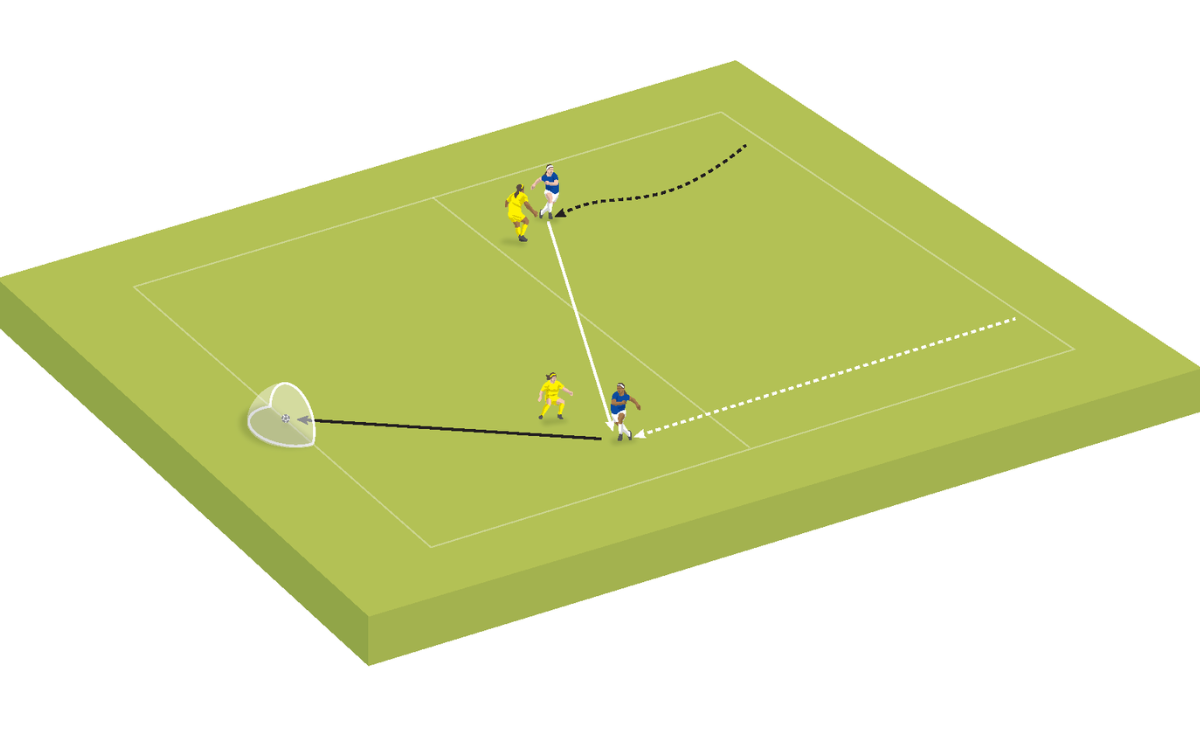
-
Divide players into groups of three. Each group should have two attackers and a defender
-
Attackers aim to complete as many successful passes as possible within the time limit
-
Defenders earn a point if they win possession and dribble out of the area
WHY USE IT
This practice builds on your players’ decision-making with regard to when to pass the ball, with an emphasis on playing forward.
Set-up
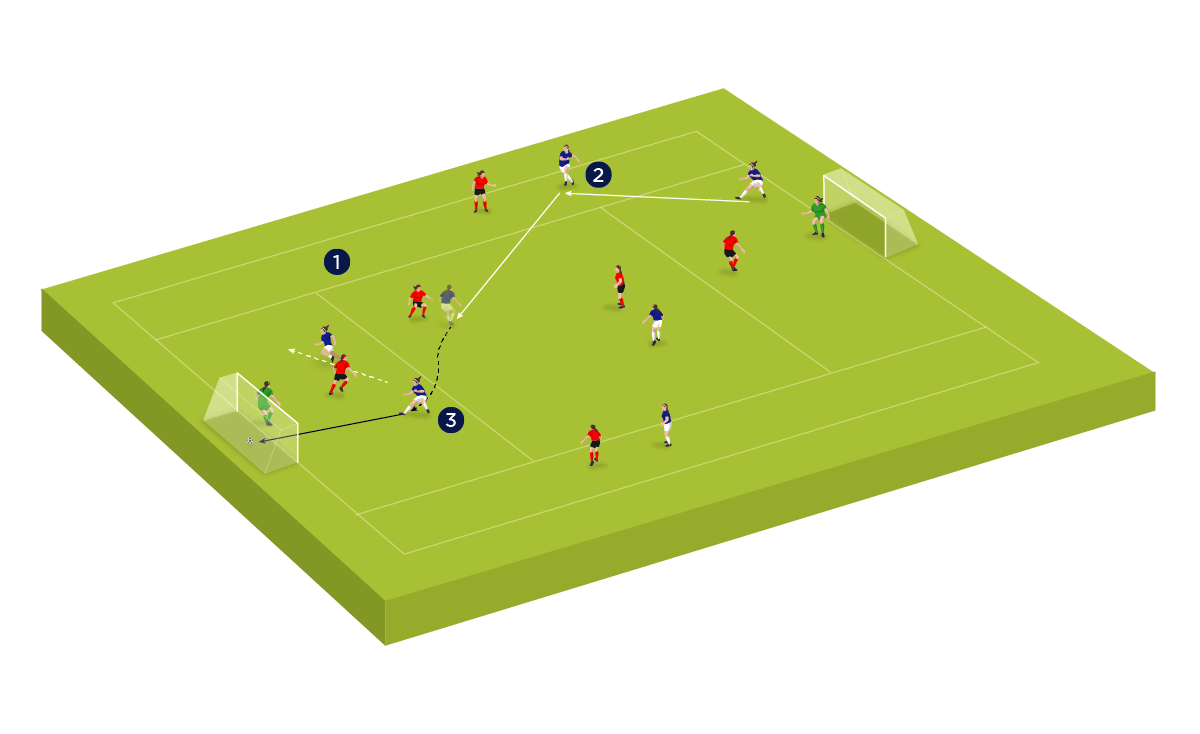
Mark out a suitably sized area appropriate to your players’ age and ability. Place an end zone at opposite ends.
Divide your players into groups of six. Mark out a pitch for each group.
HOW TO play
Position a player in each end zone. These players will act as a server for one team and the target player for the other.
Play 2v2 in the area between the two end zones. A server starts with the ball and passes it to the team attacking the opposite end. This team earns points by passing the ball to the target player at the opposite end.
When this target player receives the ball, they serve it back to the other team, who attack in the opposite direction.
Players can pass back to their server, and the server is allowed to pass straight through to the target player.
Rotate the servers/target players every 1-2 minutes.
progressions & ADAPTATIONS
-
Restrict the area the target player can move in.
-
Prohibit the server from being able to pass to the opposite target player.
-
Increase the challenge by prohibiting back passes to the server.
-
Teams can score by dribbling the ball into the end zone. This adds a further decision of when to dribble and when to pass.
-
Add a mini goal behind the target player. The target player can shoot once they receive the ball.
-
The in-possession team, after passing to their target player, must receive a pass back before they can score in the mini goal positioned behind their target player.
COACHING POINTS
Encourage players to:
-
Receive on the half-turn, so they can assess their surroundings.
-
Scan to see the positioning of their team-mate.
-
Get close to the fire without getting burned.
-
Communicate with your pass; this should tell the receiver what to do – for example, a pass played slightly in front of them encourages them to play forward.
-
Play forward as soon as possible.
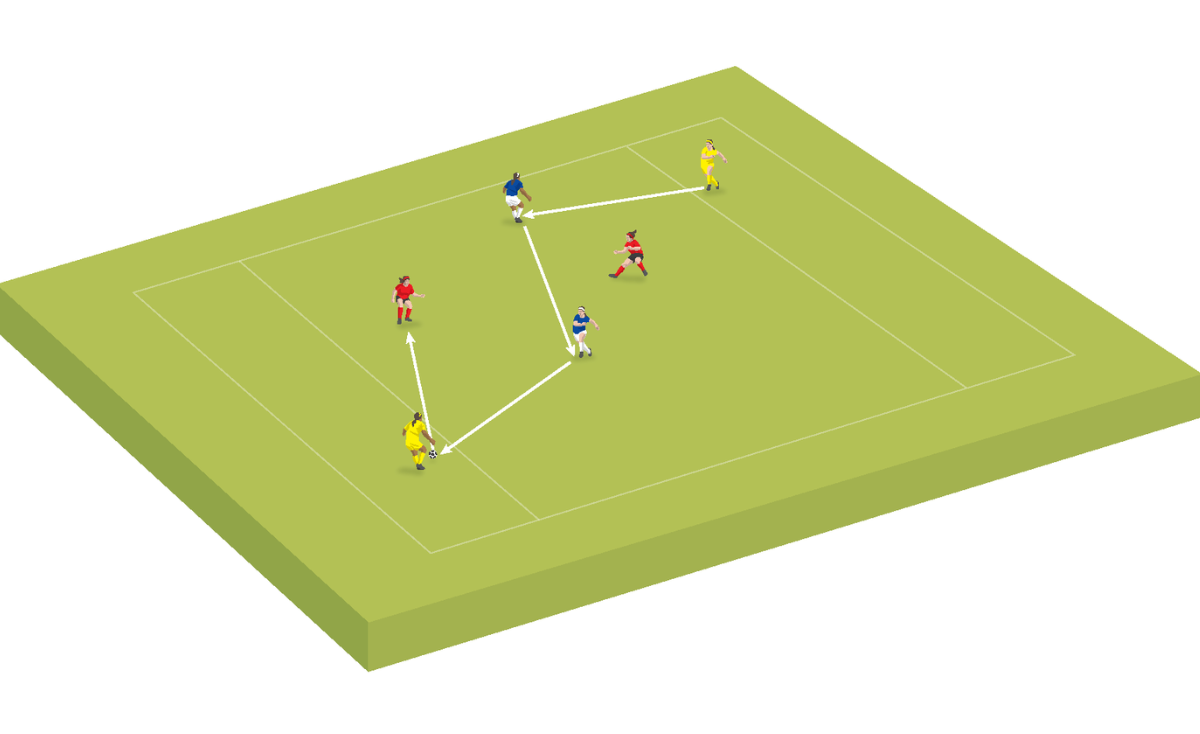
-
One player starts in each end zone, with a 2v2 in the middle area
-
Pairs in the middle aim to progress the ball from one end zone player to the other
-
End zone players serve the ball to the opposite team once a pair has scored

Paul Robinson
Latest Content
Subscribe Today

Newsletter Sign Up
Subscribe Today
Newsletter Sign Up
Subscribe Today
Latest Issue
Discover the simple way to become a more effective, more successful soccer coach
In a recent survey 89% of subscribers said Women's Soccer Coaching makes them more confident, 91% said Women's Soccer Coaching makes them a more effective coach and 93% said Women's Soccer Coaching makes them more inspired.
*includes 3 coaching manuals
Get Inspired
All the latest techniques and approaches


Women's Soccer Coaching offers proven and easy to use soccer drills, coaching sessions, practice plans, small-sided games, warm-ups, training tips and advice.
We've been at the cutting edge of soccer coaching since we launched Soccer Coach Weekly in 2007, creating resources for the grassroots youth coach, following best practice from around the world and insights from the professional game.
